

|
|
 |
Guest - Not logged in | |||
Reviews > Electronic Devices > Watches > Silva Tech4o TraiLeader 1 > Test Report by Roger Caffin
| ||||
|
Reviewer Details
|
Backpacking Background I started bushwalking at 14 and took up rock climbing at University with the girl who became my wife and my permanent walking partner. Ski touring and canyoning followed. Winter and summer, we prefer long hard trips by ourselves: about a week in Australia, up to two months in Europe/UK. We prefer fast and light in unfrequented trackless country. We would be out walking and skiing for at least three months a year. We have now moved to lightweight gear, much to our backs' relief. I designed and made much of our lightweight gear myself. I am also the maintainer of the Australian aus.bushwalking FAQ web site www.bushwalking.org.au/FAQ/. |
|
Basic Product Information
|
|
||||||||||||||||||
| Product Claims | |||||||||||||||||||
|
|
|
Product Description This is basically a large 'sports' watch, although it has many more features than just telling the time - as shown in the Product Claims above. It has an integrated perforated wrist band which can't be removed. There are four large rectangular control buttons arranged around the rim, with fairly conventional functions and layout. There is also a smaller push button for the back-illumination. This gives a gentle greenish background glow which lasts for several seconds. The numbers are quite legible in the dark when the back-illumination is activated. 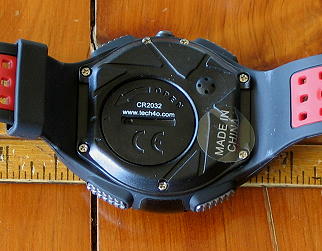
Being a large digital watch it has many functions of course, and these are accessed through 'menus' on the screen. There are two different menu lists: one for time/date functions and one for the 'other' functions. The latter is called the 'Trail' menu. Navigation within the Trail menu seems fairly straightforward: the captions 'alti' and 'baro' are fairly self-explanatory for instance. Within the time/date menu however there seem to be five very similar sub-menus. I am reminded of the 'maze of twisty little passages' for those who remember the early computer game Adventure. I have yet to learn how to use all these sub-menus. Access to the battery is through a round port on the back panel: this can be undone with a coin. The port is clearly labeled in the photo to the right. Removal of the battery does mean you lose all the settings you may have done. This is a pity as the inclusion of a simple capacitor (or 'super-cap') would prevent this. Chapter 10 of the manual gives complete instructions (page 32) for replacing the 'user-serviceable' CR2032 battery (a fairly common battery). This is good. But the warranty section of the manual (Chapter 12, page 37) cautions that replacing the battery yourself 'may void this warranty' - which seems a bit harsh considering the simple instructions given on page 32. The battery cover is sealed with a thin O-ring which stays nicely in place. The back panel itself seems to be held in place with seven small screws. These also secure the integrated wrist-strap. I have not tried to remove these screws (yet). The watch is somewhat vaguely described in Chapter 12 as 'water-resistant', but surprisingly for an outdoors watch it is not waterproof. The warranty does state 'Damage resulting from excessive exposure to water, heat or cold is not covered under this warranty.' This is strange as many far cheaper digital watches sold at service stations and supermarkets come with a 30 metre (100') pressure rating. Perhaps the inclusion of a pressure sensor has something to do with this, although I know there are ways around this problem. |
|
Initial Impressions 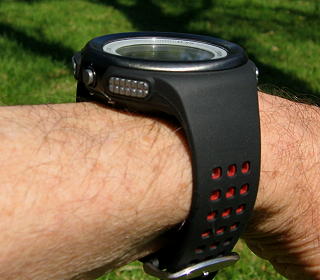
The web site may list the features, but what is not obvious from the web site is that this thing is huge! It is much bigger than I expected. In fact, as you can see in the photo to the right, it almost dwarfs my wrist. I tried to slip one of my office shirts over the watch while it was on my wrist and had to undo the button on the cuff to do so. Fortunately some other office shirts I have provide two cuff buttons, for thin and thick wrists, and the thick-wrist button position did let the watch just slip through the done-up cuff. Even so the process was difficult for me, and I can see that normally the watch would either protrude all the time or be concealed all the time. Neither is good in an office environment, and I cannot really imagine using this as a daily 'office' watch in business clothes. Whether it will be too big for wearing conveniently on my wrist in rough country, scrambling through thick scrub - that I will have to see. That said, I have to say the integrated wrist strap is remarkably comfortable. On some older watches the wrist strap was made of fairly hard plastic, but this one is soft and wraps very easily around my wrist. I could not find out from the specifications what the material used is, but I suspect it may be some sort of silicone rubber. In addition, unlike many wrist straps which completely cover my skin and make it sweaty, this wrist strap is perforated like a Johnson & Johnson Band-Aid and it allows air through. The display figures are large and clear. The control buttons on the sides are also quite large and have a dimpled surface - a non-slip design I think. The button travel is not large compared to some other watches I have owned, and I found I had to get used to the short travel. This was not difficult as the display does change
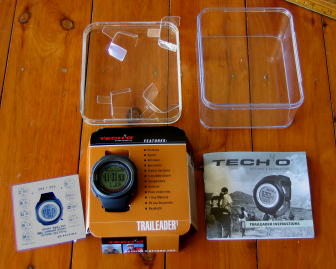
The instruction manual which comes with the watch is a bit large and intimidating. I really don't think I will ever manage to remember all the instructions for all the operations listed above. However, for the most part the manual is fairly clear. It is not completely error-free: for instance the instructions on page 36 for correcting the sea-level pressure reading refer to section 9.2 (which is on compass use) rather than the correct section 8.2. I was a bit shocked by the massive amount of packaging which came with the watch. As listed above, the watch weighs a largish 52 grams, but the packaging is over four times that in weight. Included in the packaging is a rigid plastic container resembling a small lunch box! I would love to see companies using less packaging. |
|
The Watch Functions I won't comment here on the basic time/date function or the chronometer features apart from noting that the time-keeping seems quite stable and accurate so far. We expect that these days with digital circuits, but I will monitor it and also test the alarm functions at night when I am deep inside a sleeping bag. Previous wrist-watch alarms have been relatively useless at waking me up, even in the quiet of the bush. The internal pressure sensor runs both the barometer and the altimeter. The picture of the back of the watch shows a small dimple with four holes: I believe this is the inlet for the pressure sensor. The pressure can be calibrated in imperial and metric values and also in 'bar'. One bar is the pressure at sea level on a fine day: it is quite intuitive and useful. I have been rather skeptical in the past about whether something as small as a digital watch can predict the weather just from the pressure readings. The Weather Bureau seems to have plenty of problems doing that even with all their facilities. However, there is no denying that a short-term forecast (say up to 12 hours) should be possible. This facility is claimed, and I shall be interested to see how well it works. Mind you, if it does predict a storm this isn't going to help me avoid it, but that's life when out walking. The altimeter uses the well-known relationship between pressure and altitude to determine altitude. I have found this very useful sometimes, especially in the mountains when altitude is a good position locator on a map. I am immensely pleased to find that this watch does not attempt to 'correct' the altitude setting for what might be slow drifts in atmospheric pressure - or possibly slow altitude changes. Another watch I have tested did attempt to make that correction and always got it wrong. That drove me mad. This simplicity means I should be able to trust this altimeter (and the barometer) far more - although all this has yet to be tested. There are several other altimeter/barometer functions: a profile graph, an accumulator for ascents and descents, and so on. I will be testing these to see how useful they are in practice. This watch includes a magnetic compass function, with declination correction. I have had some very unhappy experiences with the compass function in digital watches in the past. They consumed lots of power and have been very susceptible to any tilt - without warning. The manual claims that this watch will warn if the magnetic field is 'distorted' so maybe it will warn when there is too much tilt. I will be examining the performance of the compass section in this watch with some care. There is also an accelerometer in this watch. The manufacturer claims this can be used to estimate distances, speed of travel and even calories consumed. I have to say I have some doubts about the value of this on rough terrain, although I have never used a pedometer of any sort. Yes, it may be quite good when I am walking along a flat smooth track, but many times I am doing anything but that. Well, it will be rather interesting to see how it goes in the field. The watch includes a small temperature sensor, but the manual acknowledges that this will be upset by the heat from my wrist. However I sometimes hang my watch on a string around my neck, and I usually leave it in a pocket on the tent wall at night. It will be interesting to see what the 'minimum temperature' feature says about some of the nights in winter. Finally, I should comment on the huge range of 'other' functions available. I am sure a few people will find some of them useful, but the sheer complexity of accessing them all - and the difficulty of remembering how to do so, makes me wonder whether there can be 'too many features'. We have this problem with many PC software packages of course. Marketing loves them, but users often spurn them. It will be interesting to see whether any of these extra features turn out to be useful in practice.
|
The first thing to do was obviously to run through as many of the settings and functions as possible, to set the watch up and familiarise myself with how to use it for later in the field. I admit there are some obscure functions which did not get examined in any detail - consider that a reflection of my opinion of their value.
Adjusting any setting on the watch seems to always turn on the backlight, which is a very battery-hungry part of the watch. At the time of writing this part of the Initial report I had no idea why the watch did this when it has a separate button just for the backlight. Initially I thought that the action of turning on the backlight on button-press was a left over in the software from previous models and no-one had thought to remove it. However, as reported in the Long term Report section, I subsequently found out otherwise. Read the manual!
The Manual instructs on how to change settings, but does not explicitly mention what is a common and highly essential 'User Interface' feature: how to make large changes. One could of course press the 'up' or 'down' button 300 times, but ... I found that by holding the button depressed for several seconds, the watch would eventually go into a 'fast scroll' mode, and the numbers would roll past at a reasonably fast rate. This is quite common. I often overshot, but there are both 'up' and 'down' buttons so that doesn't matter.
The features of the watch are sorted into two different groups, or menus. One is basically Date and Time, while the other is 'everything else'. Changing from one to the other is simple enough, but it does mean I have to go back to the root of the appropriate menu each time. In practice this feels slightly clumsy as I have to then scroll through the new menu to find what I want. The trouble is, with this many features, it is hard to think of any better system. Well, one good solution would be to eliminate many of the relatively useless features, but I can't imagine the marketing department being keen on such an approach (witness trends on computer software).
Looking at the Date/Time section, I have to say I did not find the menu structure all that simple. This may be partly due to the fact that I cannot wear this watch on my wrist and don't get enough practice with all the options. Fortunately, the first option which normally turns up gives me most of what I want in this department: time and date. I can also get pressure trend as one of the options: this is nice. The 'other' menu also normally starts with the most useful screen: altitude history, current altitude and time, which is usually suitable. All the other features are further down the menu, and I rarely touch them.
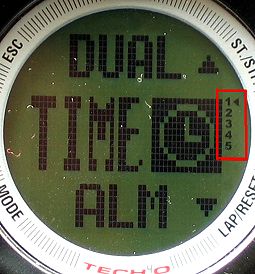
Please note that I have said 'normally' in the above. Close examination of the root menus shows that the watch is a shade more sophisticated than I have presented so far. The root menus have a feature which is not shown or mentioned in the user manual, and this is shown with a red box around it in the photo here. There is a list of numbers with a little arrow symbol beside one of them. It seems that the numbers refer to the available screens - in the Date/Time section in this case. In the photo the arrow points to '1'. As far as I have been able to determine, this means that the display will automatically change to screen 1 after a few seconds.
I can change this behaviour by going to screen 2 and then clicking the Esc button. This will bring up the root menu with the arrow now pointing at the '2', signifying that screen 2 is the now default screen. If I switch to Altitude mode and then back to Date/Time, I will go to the default screen as selected. This is neat, especially so because screen 1 in the 'other' menu is the relatively useless Speed/Distance screen. I leave it set to display screen 2: altitude.
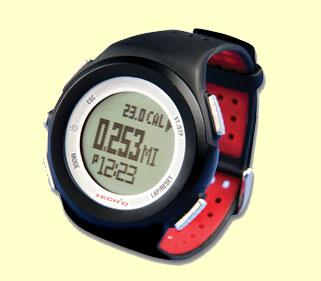
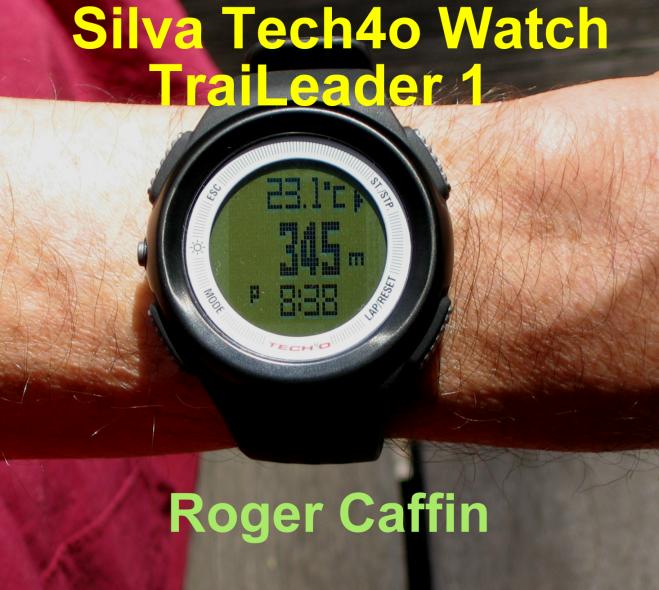
In addition, if I have configured the watch to display one particular option on a screen, this selection is remembered for when I return. For example, I normally configure the altitude display to show altitude trend at the top rather than temperature (as is shown in the lead photo). If I go to Date/Time and back, altitude trend will still be there. I think this part of the menu system is very useful.
For this I just followed the instructions in the Manual. It was straight-forward and fairly intuitive with no worries. Yes, I did follow the Manual, but I could have done it without the Manual. Some other settings turned out to be not so simple.
Dealing with the Dual Time Mode was just as simple. I set the 'dual' time to be the same as the 'current time'. I didn't find any means to switch between time zones however, and I suspect such does not exist. I did notice that when setting the Dual Time I could not alter the seconds readout, and that this seemed to be exactly the same as for the current time. I suspect this means that the 'dual time' readout is simply an offset from the 'current time' in hours and minutes rather than a separate time-keeping function. That is fine of course.
Reading the Manual first seemed to make this a very simple exercise. There are two alarm timers: Alarm1 and Alarm2. I will make a preliminary comment here: the alarm-on icon at the bottom of the display is much smaller than the Manual suggests. But the icon is there unless the alarm frequency setting is 'OFF'.
Anyhow, my procedure was to check the current time and set Alarm1 to go off a couple of minutes into the future. I set the alarm for 18:48/Daily when the time was 18:46. The alarm on icon was showing. I heard nothing as the designated time rolled past. At 18:50 I set the alarm for 18:52/Daily, and the alarm icon was showing. Again I heard nothing. At 18:53 I set both Alarm 1 and Alarm 2 for 18:57/Daily. Still I heard nothing. Surely the alarm works?
It occurred to me to wonder whether the 'Daily' part was the problem, so I changed that to show the current day of the week instead of 'Daily'. But still I heard nothing as the alarm time rolled past. I was setting up yet another test when my wife called me to morning coffee. Naturally I turned up for that. A moment later my wife asked me why I was beeping (honest!). I put the watch to my ear and heard ... a very faint beep.
In short, the alarm system does work, but the pitch is so high and the signal so faint that I cannot hear it when the watch is on my wrist - unless I put the watch to my ear. My wife says she can hear it at a few feet in a quiet environment. It may well be that my hearing (I'm 62) at high frequencies is not as good as it used to be, but this does not alter the fact that for me the alarm effectively does not work. The designers have chosen a pitch which is far too high for a significant part of the market. I would add that if my wife's head is inside a sleeping bag she can't hear the alarm either.
I played with these, and yes they work as indicated. However, as explained above under Alarm Mode, most of the functions turned out to be fairly useless as I could never hear the chimes which sound at the end of the preset intervals. The stop-watch timing may be useful for someone doing short training runs, but I did not find it useful when bushwalking for several days in the mountains.
I like having an altimeter with me in the mountains, especially one which is reliable.
The first thing to do here was to adjust the altimeter to give the right height for my house, at 188 m above sea level. Emboldened by the simplicity of setting the time and date, I tried to adjust the altimeter reading without checking the Manual. This was a mistake. I went through the relevant menus several times without success: I could not see what to do. But it turned out this was simply a matter of terminology: I was expecting something different from the 'function names' offered by the watch. In this case, blame the user.
Adjusting the altimeter to a local known altitude is done via the 'Alt Ref' setting. Once I found that out the rest was straight forward. Read The Fine Manual!
No sooner had I set the altitude correctly than it started drifting upwards. Switching to the barometer display showed a fast decreasing pressure. Oh? Hum - a barometer falling this fast means ... a storm is coming. It hit an hour later, quite abruptly. This does happen around Sydney where I live. An interesting test of the sensitivity of the pressure sensor.
I also liked the little graph available on the pressure menu. It showed the sudden crash in air pressure on this occasion quite nicely. I may not be able to predict the weather for the next week with this watch, but I think I can foresee storms within the next 6 to 12 hours. This is nice, and seems reliable.
Even more interesting and totally gratifying was the discovery that after the storm had passed the altitude of my house returned to the correct value! Another watch I tested had my house wandering up and down in altitude by 100 m (300 ft) over a week, making the readings rather useless. This watch has an 'honest' pressure sensor which simply reports the current pressure as measured and does not attempt any fancy corrections. I was greatly cheered by this.
I have played a little with the barometer and altimeter logbooks or data collection facility. They work, and can be entertaining, but the reality is that such historic data has never been of much use to me - with the exception of the pressure graph which can be displayed on the normal Time/Date display.
One has to wonder: the Compass section of the manual (9.0) opens with this statement: 'make sure you are not using this feature near any magnetic field'. The mind boggles! Who wrote this Manual?
There is a second amusing note in the Manual under section 9.5, which states that 'True North is static and located geographically about 800 miles north of the magnetic pole'. That statement might be correct if you live somewhere near New Orleans in America. I can emphatically state that it is completely wrong for a person living in Sydney, Australia. The declination here is about 11 degrees. This may sound pedantic, but when I see gross errors like these two I worry whether the designers of the watch really know what they are doing. But maybe the fault lies solely with the writer of the Manual.
Anyhow, I followed the Manual for the calibration process. It says to put the watch into compass calibration mode, then hold the watch horizontal and rotate it once over 30 seconds. This was not difficult: I sat in my office chair holding the watch and slowly spun the chair around. As I did so, a black border crept slowly around the edge of the watch, showing what readings it had taken. There were some gaps at the end of one rotation, so I did a second rotation more slowly and 'filled in the blanks'. However, I have to say that the performance of the compass before and after this exercise did not seem to be noticeably different.
I have not had a lot of joy from little compass sensors in watches in the past. Sadly, I have to report that this watch compass seems no better. I do not believe this is a useful feature. However, my testing showed the following.
The Manual states under section 9.2 that 'Compass mode will go to idle to save battery power if no change in direction has been sensed for one minute'. This power-saving is a commendable idea but probably irrelevant in the field. More important is the note in section 9.3 which states that 'the compass will go to idle (sleep mode) after 1 minute of use'. This does happen. When doing tricky navigation in difficult country I have been known to hold my simple magnetic compass in my hand, actively monitoring it, for up to an hour at least. I can see a usability problem here.
Section 9.5 shows how to lock the readout in compass mode. That is, if the watch is pointing north (0 degrees) and I press 'lock', the readout will continue to display 0 degrees no matter where I point the watch. I can confirm that this works, but I have absolutely no idea what possible value it might have. None at all would be my opinion.
A big worry is always how the compass handles a slight tilt. With a conventional magnetic (needle) compass I can see whether the needle can swing freely, but with a watch I have little idea of whether it is level. That said, the Manual does say the display will flash if the watch detects 'distortion', but this seems to refer to nearby speaker magnets and the like. So I set up the watch on a jig and measured what tilt in two directions would do to the reading.
Tilting the watch downwards in the direction of North by up to ~10 degrees did not alter the readout in compass mode. Excellent. Tilting downwards in excess of this caused the bearing to be significantly wrong and for the display to start flashing - a warning that the bearing shown is not reliable. Excellent. Tilting the watch towards the South by up to 80 degrees did not alter the bearing displayed. Excellent, albeit strange. I suspect the high tolerance to a southwards tilt is most likely due to the prevailing magnetic dip, which in Sydney, Australia is 'southwards' in this context.
A tilt sideways of 45 degrees was accepted by the watch without any indication of trouble, but the compass reading was then wrong by over 50 degrees. An example of this 'tilt sideways' is when the watch is pointed to the north with a reading of 0 degrees and then rolled sideways to the east or west. The error seemed to be linear with tilt. My concern here is not for tilts of 45 degrees, but that a tilt of a few degrees would give a bearing which is wrong by about the same number of degrees, and that I cannot tell when this is happening. Yes indeed, there are times in the bush when I am navigating or taking bearings to within a few degrees. This makes this compass too unreliable for me to trust in the field when things get difficult.
I have to start by saying that pedometers and accelerometers simply do not work for much of the bushwalking I do. I am sure that if I was walking along a level track at a fixed speed it might function. But going through the Australian scrub - no. We sometimes refer to some of the scrub or bush we go through as '4WD territory'. That's human 4WD, not cars: we are using both arms and legs to get under, over and through. Ah well.
Nonetheless, I tested some of these functions. The first thing to do was to adjust the weight setting. The Manual gives simple directions. I was interested to note that the default setting is 79 kg (174 lb).
I briefly experimented with measuring and setting my stride length. Yes, it can be done, but a fundamental requirement is a known distance along a trail. I would need to survey out a distance of a few hundred metres (or yards) in the bush for this to be done. I have neither the survey equipment nor the time to do this sort of thing, considering how variable the bush is around here. The results just would not mean anything.
Anyhow, I experimented with the standard settings after reading the Manual. At first it didn't work at all. That turned out to be due to the instructions in the Manual being rather confusing. I interpreted the statement in section 6.2 'The runner icon will flash when Speed & Distance mode is ready' to mean that it was 'ready to start'. What it really means is that the runner icon flashes when the watch is recording. But that was soon sorted out.
I found that walking along swinging my arms did record fairly well. The display did not update as regularly as I would have liked, which was slightly confusing. The reading seemed to jump at irregular intervals - but it did register my arm swings.
But I don't normally swing my arms when I am walking with a pack. Very often my left hand is tucked into my pack waist belt, or hooked into a loop coming from the shoulder strap. Under these conditions the standard accelerometer sensitivity level of 1 seemed to be a bit unreliable. Sometimes it didn't record for a noticeable distance. Increasing this sensitivity to level 3 seemed adequate to register most of my paces even when my arm did not seem to be moving relative to my body. Of course, that didn't make my paces any more uniform in length. So the whole accelerometer part works, but it does not seem very useful for my sort of bushwalking.
There is a thermometer inside the watch. If the watch is on my wrist the temperature indicated is somewhere between my skin temperature and the ambient. This is of little use to me (or anyone). If I put the watch in the gear pocket on the inside wall of my tent it will register the approximate ambient temperature after a short while - usually a degree or two above the outside temperature. This information may be interesting, but I have to point out that it is not a huge amount of use to me.
Actually, the inclusion of a temperature sensor inside the watch is vital for the proper calibration of the pressure sensor, so I am not complaining.
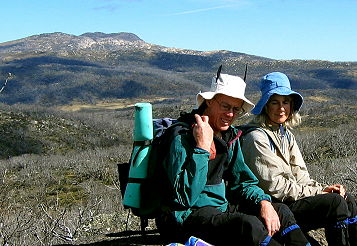
In simple terms, the problem was that the large size of the watch on my wrist very quickly made it a severe encumbrance for me each time. I had to take it off and carry it in my pack each time. This is explained in detail below.
For the watch to be useful I have to be able to wear or carry it conveniently. This turned out to be almost impossible for me. I found that the watch is simply too big and too heavy to be worn comfortably in the field. The wrist strap itself is comfortable enough, but if the wrist strap is adjusted tightly I get a cold hand due to a tourniquet effect. When I'm walking hard my wrist pumps up a bit (so do the rest of my muscles), so the strap becomes tighter, and blood flow to my hand is inhibited. This can be dangerous in the cold and especially so in the snow. This is not theoretical: it has happened to me in the snow several times. But if the strap is set any looser, to avoid this problem, this watch bangs up and down against the bones of my wrist, annoying me to no end. I didn't leave it there long enough to see if bruising would result.
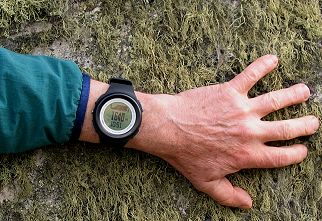
In addition, when the strap is not really tight the watch flops around a bit around my wrist, which I found to be annoying. The feeling of this large 'thing' on my wrist floating and banging around was just not satisfactory. It was too intrusive.
On top of all this, the watch is so big it was incompatible with whatever sleeve cuff I was wearing. Normally the cuffs on my walking shell are bound with Lycra for a snug fit around my wrist, as may be seen in the photo here. The watch could sit outside my clothing all the time - meaning both it and my wrist would be exposed to the weather. The watch is not 'waterproof', by the way. Or the watch could sit inside my cuff, but then it is of little use without a struggle to get it into view. Sadly, this seems to be a no-win situation.
At home I found a related problem. I often remove my watch and sit it on the desk face upwards where I am working. I normally do this by folding the watch strap against the back of the case. However, the almost rigid strap on this watch prevents me from ever doing this. The watch is stable on its side, which is very hard to read, and fairly stable upside down on its face.
The pressure sensor worked just fine in the mountains. This gave me accurate barometer and altimeter readings, which I could verify against the topographic maps I was carrying. But in addition the weather prediction system seemed pretty good too. There was one morning when I was a bit dubious about the coming day's weather: there were some clouds rolling in. But the prediction was for 'sun and cloud', and so it proved. The pressure graph stayed high and level all day too.
I would actually be quite happy if someone made a small inconspicuous moderately waterproof wristwatch/altimeter with no other functions. It would meet my needs without being party to 'creeping featuritis'. This watch is not it.
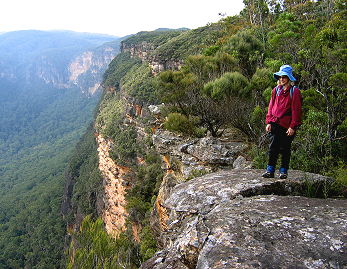
To be sure, the time/date functions work fine - although the alarm is useless for me as I can't hear it. The pressure sensor, barometer and altimeter functions are very reliable and have worked wonderfully. I could tell how far it was to the top of the cliff line (right) for instance - not that it made climbing up any easier! The compass is simply too unreliable for me to bother trying to use it. The accelerometer and related functions registered movement but the accuracy in uneven country (such as around these cliff lines) was, at best, unknown. The function seems to be superfluous to my needs in the conditions where I walk.
But the really big problems I ran into are the physical dimensions: the size and the weight of the watch and the stiffness of the watch band. They are all excessive and make the watch almost unwearable for me. Every walk I have tried the watch on has resulted in it being taken off my wrist and placed in my pack. I just don't want to have a large clunky thing annoying me when we are in this sort of country. Naturally, having the watch in my pack severely reduces its usefulness. I am really disappointed by this.
A very harsh assessment at this stage would be that this watch has been made for the young, male, feature-happy machismo market, not for serious outdoors walking (especially off-track) and not for mountaineering use. This is a pity as many of the functions are quite good. I do wish the company could slim the watch right down, excluding the compass and accelerometer components and the bulky wrist band.
The watch has been with me on a number of day trips since the Field Report was written, under various conditions. The conditions don't really matter as the watch travelled in the top pocket of my pack almost all the time. I ceased trying to wear it for the reasons given. It has also been used a fair bit at home, in the workshop, while I was data logging for extensive stove testing. Under these conditions I propped it up with lumps of metal so that the dial could be read easily - although owing to its heavy design it did try to fall over every time. Lighting conditions for this use varied from bright sunlight to shady.
The watch has functioned very smoothly over the entire test period. The time and barometer functions have been very reliable, giving me no qualms at all.
Once or twice I noticed that the display had changed while the watch was in my pack or my pocket, and I would say that meant a button on the side had been compressed accidentally. However, no harm had been done, and I can't blame the watch for the changes. After all, I packed it, so the compression was my fault. I would say that this is a hazard for any electronic gadget with buttons.
I had commented in my Initial Report that the backlight turned on every time I pressed a button. I had assumed that this was a software bug, but another BGT Tester subsequently alerted me to the fact that this behaviour can be turned off. Indeed, when I investigated more carefully I found that quite a few of the behaviours could be altered from somewhere in the Time/Date menu. These little electronic gizmos get more complex every year, and reading the manual becomes more and more necessary. I certainly can't claim this is a bug as the manual does cover it. Let's just say that it can take a fair bit of reading of the Manual to understand and set up all the features of this watch according to the User's preferences. I would go so far as to say that there is so much functionality there that it may not be possible to absorb it all in one go - I couldn't anyhow.
Anyhow, after studying the Manual, especially the steps in 'Section 1.7 Adjust Backlight Setting', I pressed the Mode button for 3 seconds as directed and found a menu saying Time, Date, General and Unit. I scrolled down to General, clicked the Mode button, and got another menu which said LCD, Sound, Light. I scrolled to Light and pressed Mode. This gave me a menu which said Light, Normal, Night. Incidentally, the manual does give a quite adequate description of all these steps. The Night option was highlighted, so I moved the highlight to Normal and rolled back out of the menu system. Actually, I didn't need to roll back: the menu system can do that by itself after a while, taking me back to the main Time display. And the backlight no longer turned on with every button-press. Wonderful!
There is one thing which I should point out here. The Manual does give good clear instructions on how to access and change every menu item. What the manual does not give is a clear explanation of what each menu item means. In the case of the backlight, the manual does not explain that 'Light' means the backlight is turned on, Normal means the backlight is not turned on, and 'Night' means the backlight is turned briefly on when I press the button - so I can see what change I am making. But it isn't hard to guess these things.
I used this watch a fair bit in my workshop for some data logging. The one thing I did notice while doing this is that the numbers in the middle of the display (ie the principal item in the display) were formed with very square shapes using rather wide or fat lines. A good example is the number '345' in the first (headline) photo. The bottom line of numbers ('8:38') in that photo used much thinner lines (single pixels rather than double pixels). I found the very square chunky or fat number format less than entirely clear all the time. Thinner lines (smaller pixels too) and a more rounded number format would be more readable in my opinion - although the problem is not large.
I have also been monitoring the behaviour of the pressure/altimeter function as I do rely on this at times. The pressure around my home in Sydney, Australia has been going up and down quite a lot over the last few months as a series of storm fronts have rolled over the mountains and/or curled around the bottom of the continent. I have been able to watch the pressure go up and down quite easily. What I did notice one day was that the pressure sensor seems to be read about every 5 - 10 seconds, not 'continuously'. This makes a lot of sense, as doing it this way means that the barometer section of the electronics can be powered down for most of the time. This saves on battery life. I only really notice this when driving up or down a steep hill in a car: the height changes in little jumps rather than smoothly ramping. I definitely prefer the way the watch saves on battery life.
I have also 'tested' the altimeter function for sensitivity, by taking readings on the floor of my office and at the ceiling. The watch accurately reports a change of 2 metres in altitude within 5 - 10 seconds. This simple test has given me a lot of confidence in the unit.
I stand by my characterisation of this watch as being really targeted at the young, male, machismo street market, not at walkers travelling the backcountry. This does not affect the very good functionality of the watch, just the exterior size and weight.
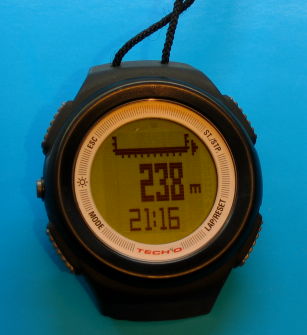
It is BackpackGearTest policy that the item under test remains the property of BackpackGearTest until the Long Term Report has been accepted and uploaded. However, once that had happened I was free to cut the bulky strap off the watch, drill two holes in the stub of the strap at the 'top' side, and thread a length of cord through these holes so I could hang the watch around my neck, as shown here. This has made the watch much more useful to me in the field. It has also allowed the watch to lie flat on the table for use when I am testing various bits of gear like stoves.
 fairly smartly when a button is pressed. The button layout for this class of watch seems to follow some sort of industry convention: top left is for major mode-swap, bottom left scrolls through the menu inside a mode, top right increases settings and does some start/stop functions, bottom right decreases settings and handles reset and lap functions. Most of these are fairly standard functions.