

|
|
 |
Guest - Not logged in | |||
Reviews > Electronic Devices > Watches > Timex Expedition E-Tide Temp Compass > Test Report by Ralph DittonTIMEX EXPEDITION E-TIDE TEMP COMPASS WATCHTEST SERIES BY: RALPH DITTON INITIAL REPORT: 27th April, 2008 FIELD REPORT: 30TH JUNE, 2008 LONG TERM REPORT: 24th August, 2008 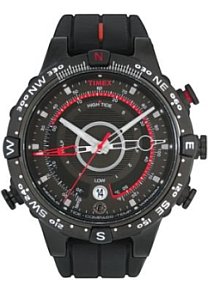 (Photo courtesy of Timex Corporation) INITIAL REPORT Personal Information Name: Ralph Ditton Age: 56 Height: 1.76 m (5 ft 9 in) Weight: 71 kg (156 lb) Email: rdassetts at optusnet dot com dot au Location: Perth, Western Australia Bushwalking Background I have been bushwalking for over eight years. My playgrounds are the Bibbulmun Track and the Coastal Plain Trail. I aim to become an end-to-end walker of the Bibbulmun Track. I am nearly there as it is 964 km (603 mi) long. Just on 200 km (124 mi) to go. My pack weight including food and water tends to hover around 18 kg (40 lb) but I am trying to get lighter. My trips range from overnighters to five days duration. My shelter of choice is a tent. Product Information Manufacturer: Timex Corporation Manufacturer's URL: http://www.timex.com Model: Expedition E-Tide Temp Compass Year of manufacture: Assumed 2008 Listed weight: Not listed Measured weight: 90 g (3¼ oz) Measured diameter: 46 mm (1.8 in) Measured thickness: 13 mm (0.5 in) Measured watch width (band pin to band pin) : 54 mm (2.1 in) Measured watch band length (including watch and buckle): 250 mm (9.8 in) Measured band width: 19 cm (0.75 in) Measured band thickness: 3.5 mm (0.137 in) Watch band material: Black 314 Nylon strap Dial: Black with Red highlights (Four other models have a white, cream, ivory or coloured dial with black highlights) Night-Light: Indiglo electroluminescent with luminescent Hands Water resistance: up to 100 metres (328 ft) Measured diameter of crown and push buttons: 5 mm (0.2 in) Battery type: CR2016 MSRP: US$159-05 Product claims 0 Tide clock
Basically, the Timex Expedition E-Tide Temp Compass is an outdoors/backpacking watch that works by analog movement which is encased in a stainless steel case. It has a very big face that is quite busy with information relating to time, temperature, tide, compass and the date. The numerals on the actual face under the glass are very tiny and I need my glasses to read them. The compass numerals on the bezel are large enough for me to read without my glasses but I do need the glasses to see the declination angle graduation markings. There are four hands on the face. These are an hour hand, minute hand, second hand and a dedicated hand which indicates the tidal trend, or current air or water temperature, or magnetic north with the push of the appropriate button. As this watch is an analog, there are no menu's to scroll through. This is a "what you see is what you get" watch. There is an instruction sheet printed in English, French and Spanish. It is lacking in one very important detail. There is no information as to which end of the indicator hand to use when trying to read the current tide position as there are arrow heads at both ends. The dedicated indicator hand at the red end has an arrow head inside an arrow head. (See above photo). This is to allow me to read the temperature scale much more accurately as I can just see through it. I will now go into the various features of the watch. Tide clock The instructions state that the tide is rising when the hand is pointing left and falling when pointing right. The number of hours to the next high/low tide is shown on the tide scale. The numerals on the left start at 1 opposite the 11 o'clock position and go to five at the 7 o'clock position with the understood 6 at the 6 o'clock position. It is marked as "Low". The numerals starting on the right at the 1 o'clock position is 5 reducing to 1 at the 5 o'clock position, again with the understood 6 at the 12 o'clock position which is marked as "High Tide". The Tide Clock uses the moon position to predict high and low tides, which are six hours and twelve and a half minutes apart. Tides are also influenced by sun position and shape of the shoreline, so the Tide Clock cannot precisely give times of high and low tides. Testing at home by pushing the bottom right hand button which is the tide button, I checked it against the nearest beach to me which is Fremantle, some 15 km (9 mi) away. The Bureau of Meteorology has high tide at Fremantle for Monday 28th April at 1256 with low tide at 0140 tomorrow morning. The reading on the watch at 2130 has the following conflicting readings. The red end of the indicator hand is at the 10 o'clock position and rising to High Tide and the silver pointy end is falling to the 4 o'clock position. If I take the silver end of the indicator hand Low Tide should be occurring about 2 hours twelve minutes time taking the time to 2342, some one hour fifty eight minutes short of the low tide mark. This is where I have some concerns with the lack of information in the Instruction Sheet about how to read the dedicated indicator hand. If I took the red end of the indicator hand then it is clearly wrong. As far as I know, the difference in hemispheres should not make any difference as the phases of the moon are the same in both hemispheres at the same time. Thermometer To get the best results from the thermometer I must take the watch off my wrist as my body heat affects the result. I must leave it off for a number of minutes so it will cool down to the environment. By pushing the top right button that has a red band around it the indicator hand moves to the current temperature. The scale is in both Celsius and Fahrenheit. I took a reading outside my home at 10 pm and these are the following readings, Bureau of Meteorology Perth Airport which is the closest station to my home some 11 km (6.8 mi) away, 15.1 C (59.1 F), my Kestrel 3500 Pocket Weather Meter, 18.5 C (65.3 F) and the watch, 23 C (73.4 F). That is a very big variance. In fact, every time I fiddled around with the temperature button on the watch, the indicator hand seems to hover around the 23 to 25 C (73.4 to 77 F) irrespective of the prevailing temperature as measured against my Kestrel unit. This will need more testing. All the manufacturer states is that there is a temperature sensor which I can not see as it must be encased in the body of the watch. My Kestrel has an exposed thermistor which responds quickly to change in temperature, and I must admit, I did expect to see something like that even if the end was flush with the side casing so as to "sniff" the outside and still maintain a watertight seal. The Instruction Sheet states that the watch can take water temperature when submerged. Knowing my luck this would be a sure kiss of death so I will not even attempt to do so as I have no need to test the water temperature when bushwalking. My fingers can do it pretty well if I am curious as to how cold the water is. Compass Reading the instructions on how to use the compass feature, it mentions that it must be calibrated. I immediately thought of my GPS which has to be calibrated every time I change batteries and wondered if it was the same method, rotate the unit slowly for two revolutions taking at least 15 -20 seconds for each revolution. Reading on further I was pleasantly surprised to find that this was so, with the only variation being pulling out the crown button (middle button on right hand side) to the middle position, then pushing the compass button on the left hand side of the watch prior to beginning the revolutions. I had to retry about four times as I was either too jerky or quick in turning the watch. To make sure that I had it right, I checked the watch against my own compass and found it to be spot on. To operate the compass I hold the watch level, press the compass button and the indicator hand moves to magnetic north. After 20 seconds, the compass will automatically turn off to conserve battery life. If I find that the 20 seconds is not enough, I just keep pressing the compass button to keep the compass working. There is a declination angle graduation scale on the bezel (see above photo) between the 330 and 030 degrees. The intervals are at 2 degrees. Where I live and bushwalk, the declination variation is only 1 degree so I really do not have to use this scale. There are two methods to use this compass. 1) Which way am I headed? I hold the watch so that 12 o'clock is in the direction that I want to travel. I then turn the compass ring until the indicator hand is pointing north on the ring. 2) Which way should I go? I turn the compass ring until my desired direction (e.g.NW) appears at 12 o'clock in the direction that I want to go. I then turn my body until the indicator hand points north on the compass ring. To help with sighting an object to walk towards when taking a compass reading, there is a red line on the wrist strap (see above photo). All I have to do is to twist my wrist skyward and sight along the red line. Time/Date A watches basic function. There are no numerals on the watch face, just dashes for minute intervals and little silver coloured squares for the hours except for the 12 o'clock position, the "M" in "TIMEX" is the substitute and at the 6 o'clock position the logo "E" is the substitute. The hour and minute hands are large with a luminous paint strip for night reading. The second hand is a skinny red one without any luminous paint strip. (See above photo). Setting the time was very easy as the instructions are straightforward. The date is just a numeral for the day of the month. It is located just above the six o'clock position. The only thing that I had to be careful when setting the date in the afternoon was to ensure that the date changed at midnight, not midday. I had to set the time by going over twelve hours plus whatever the appropriate time in the afternoon was when I set up the watch. To date, both have kept an accurate record. I have not noticed any loss or gain of time when compared to my household clock. Initial Impression What I saw on the web site picture wise of the watch is what I received so there was no surprise there. However, there was no instruction sheet available on the web site for the watch. Fortunately one was supplied with the watch. What did surprise me was the large size and chunkiness of the unit. I thought it might be large but it was larger than I imagined. This is not to say that it swamped my tiny wrist or felt very heavy when wearing it. I definitely know that I have it on. I have had no trouble doing up my cuff when wearing the watch. There are twelve hole intervals on the watch strap for the tongue of the buckle to be housed in. I mainly used the sixth one in from the end of the strap to give me a snug fit of the watch. 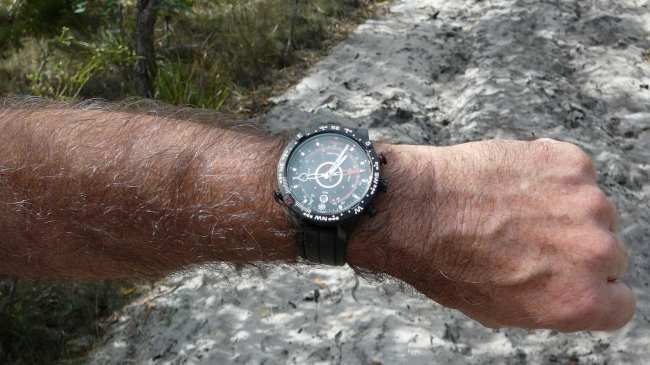 There was no issue with any non functioning buttons or broken wrist band. The watch was in good shape upon arrival. It even had a silicone guard around the crown button to protect it. I have worn the watch for a full days hiking so far. I found that I did perspire under the band and it became a bit uncomfortable. I took it off and wiped the base of the watch and my arm, replaced it back on my arm a little bit looser to the fifth hole from the end, as my wrist had swelled a bit due to the heat. It was 22 C (72 F), very still, and the humidity was 61%. It had rained earlier in the morning. By pressing the crown button in, the Indiglo night-light illuminates the watch face for about six seconds if I just press it in and let go straight away. If I hold the crown button in the light stays on. I can read the time easily but I cannot see the points on the dedicated indicator hands. I put that down to my poor eyesight as I have to use glasses to read the face. There is a splash of luminous paint on the red tip of the dedicated indicator hand and I can only barely see it with my glasses on. (See top photo for the splash of white). I would only be guessing as to what it was indicating. Summary I am impressed with the compass aspect. It points to magnetic north as indicated by my own compass, so that is a correct feature. The instructions need to be clarified regarding the reading of the dedicated indicator hand for the tides. If the silver end of the hand is the correct end then it is roughly correct to my local tides within two hours. I can live with that margin. The date and time aspect are spot on and were very easy to set up. Temperature readings? Ummm. I really need to give this a good shake out as the needle seems to like the 20 to 25 C (68 - 77 F) range when the real temperature is lower according to my Kestrel 3500 Pocket Weather Meter. Maybe it will ride up with wear so to speak! Time will tell. This concludes my Initial Report. The Field Report will be amended to this report in approximately two months from the date of this report. Please check back then for further information. FIELD REPORT DATE: 30th June, 2008 Field Locations and Conditions My first field trip was north of Perth on the Coastal Plain Trail. This trip was a three day, two night adventure. Elevations ranged from 40 to 60 m (131 to 197 ft). The soil was very sandy. Temperatures ranged from an evening low of 9.9 C (50 F) to a daytime high of 23 C (73 F). Relative Humidity over the trip went from the mid 40's to 93%. It rained on the second morning for a few hours curtailing any hiking as I had two small children with me. I carried a printout of the weeks tide times from our Bureau of Meteorology and I checked the indicated tide times by the watch against my printout at various intervals. I used the silver end of the indicator hand to read off the tide positions. There was only a slight difference between what the watch indicated and the official time. E.g. I took a reading at 1720 hours and the watch indicated a low tide in two hours which is the 4 o'clock position. The official Low Tide was at 1943 hours. I took another reading at 1925 hours and the watch indicated Low Tide. I can live with an eighteen minute difference. I have received similar results for a rising tide also. However, I will continue to monitor the tides to see if there are any major blowouts of time difference. I am still getting differences with temperature results as indicated by the watch to the official temperature and my Kestrel 3500 weather station. Out in the bush they are all converging to a closer result. E.g. I had readings from the watch at 1400 hours of 23 C (73F), the Bureau of Meteorology (BOM) 21.6 C (71 F) and my Kestrel unit 21.4 C (70.5 F). A further reading at 1604 hours gave the following results: watch, 23 C (73 F); BOM, 22.1 C (71.7 F); Kestrel unit, 22.9 C (73.2 F). Later that night at 2240 hours I took another reading of the units and recorded the following: watch, 13 C (55 F); BOM, 13.3 C (56 F); Kestrel unit 14.3 C (57 F). So they are reasonably close. It would appear that the cooler it gets the more accurate the watch's readings become. I had left the watch off my arm for many hours resting on a wooden table. I carried my own personal compass with me as a check against the watch's indication of magnetic north. It lined up accurately with my compass magnetic north heading. The declination angle on the Coastal Plain Trail is 1 degree. I did not have to use my compass or watch for any bearings as the tracks are well marked. The watch has kept reasonable time and I have worn it constantly when exploring away from my base camp. I did get sweaty under the band and I had to loosen it off a bit as my wrist did swell from the exercise. I found this operation relatively easy to do when walking. At night I could just tell the time due to the luminous paint on the hands, but it was difficult as the luminescent hands are not very distinct. When I used the Indiglo Night-Light I did not find it much of a help when trying to read the temperature, as a matter of curiosity. I had to use my headlamp. I am still in two minds as to how effective this light is. My second field trip was over two days and one night south east of Perth. This trip was an off track exploration of granite Monoliths in an area hardly visited by anyone. My group was looking for Gnamma water holes. This was all compass and map navigation. Elevations ranged from 320 m (1,050 ft) to 423 m (1,388 ft). Temperatures ranged from an evening low of 12 C (53 F) to a daytime high of 21 C (70 F). The night was clear and the Relative Humidity on the evening reached 89 %. The Dew Point reached a low of 10 C (50F). This meant that condensation on and inside my tent was a fact of life. I took a temperature reading from the watch at 2100 hours. It showed 17 C (63 F). The BOM recording was 16.1 C (61 F). I had taken the watch off so as to get a much more accurate reading. I took another reading at 0700 hours the next morning and the watch indicated 12 C (53 F). The BOM also showed 12.0 C (53 F). A perfect match. I did not carry my Kestrel unit on this trip. I was cutting weight to carry. I did not take any tide readings. I did from time to time take compass bearings with the watch as a follower in the group. However, I used the main compass and map when it was my turn to lead a section walk as it was much quicker to use and it did not cut out after twenty seconds. A few observations came out when wearing the watch. The very first problem that I encountered was that when I was putting my back pack on, the watch buttons would catch on the left shoulder strap. I have always hauled the back pack up onto my right knee and inserted my right arm through first. Then I put my left arm through. After getting fed up with getting the buttons caught on the strap after every rest and meal stop, I tried doing my left arm first. This worked without the watch buttons getting caught, but it went against the grain of putting the pack on. I guess it is a matter of getting used to doing it differently. Also, I left the cuff undone so that the material covered the watch. When I had the cuff button done up, the sleeve would ride up my wrist, exposing the watch to the scratchy vegetation. Since I set the time on the watch when I received it on the 25th April, 2008, it was roughly two minutes slow a fortnight later. My third field trip was a day walk with the Perth Bushwalkers helping a leader with an Introduction Bushwalk. The hike was over 18 km (11 mi) with 90% off track using a compass and map. Here I got a chance to use the compass facility. By obtaining magnetic north I could then orientate the map and pick out the land features around me as depicted by the map. More importantly, I could then proceed to the next feature at a tangent to magnetic north. I only did this for a few monolith outcrops as the leader took over leading with his compass and map. At least I could navigate using the compass feature on the watch for short distances of approximately 2 km (1.2 mi). Once again I got caught out nearly every time when I went to put my day pack on. The watch would get caught on the pack shoulder strap. I had to have a mental shift and consciously put my right arm through the strap first before my left one. On the fourth trip, I was away for three days and two nights at Boyagin Rock exploring the granite monoliths in the area. The Boyagin Rock bushwalk was all off track using a map and compass. I led sections of it. From time to time I used the watch to find magnetic north and checked it against the compass. It was accurate at all times. I did not worry about tide times as I was hundreds of kilometres (miles) inland. The weather was very wet on the Saturday as it rained all day. The Sunday and Monday had heavy fog until the sun burnt it off around ten am. Temperatures ranged from a low of 5 C (41 F) to a daytime high of 18 C (64 F). The Saturday high did not get over 9 C (48 F). The temperatures were taken using the watch after it had been off my wrist for a good hour so that it could acclimatise to the surroundings. I found that if I took a temperature reading with the watch on my wrist, there is a discrepancy when I remove it and let it cool, so to speak to the surrounding environment. I did this on my next trip to Queensland. The temperature reading with the watch on was 23 C (73 F) and when I took it off and read it about twenty minutes later the temperature reading was 16 C (61 F). That is a big variation, some 7 C (12 F). The colder the environment, the bigger the discrepancy as the watch is being heated by my body temperature. The trip to Queensland involved a two hour time difference and I had no difficulty in turning the watch forward on the plane. I did not have the instructions with me but I just pulled the centre crown button all the way out and adjusted the time. I did the same process when I was returning home. I also set it to the correct time as it had lost a few minutes again. Again I did not check the tide movement of the watch to the tide times as I was inland on top of the Great Dividing Range some 100 km (62 mi) from the sea. When I wear the watch, I have had no difficulty with my left hand shirt cuff being too small to accommodate the watch. What I have found though is that I do perspire under the band and my skin becomes itchy. This usually occurs after about four hours of wear. If I am active, my wrist expands slightly so I have to adjust the setting of the watch buckle to make it looser. In addition, the hairs on my wrist around and under the watch band get irritated with being tugged when the watch slips around on my wrist combined with slight perspiration. Sometimes it gets so irritating that I have to take the watch off to give the hairs a rest and let the skin settle down. My last trip during this reporting period was a day walk of 16 km (10 mi) in the John Forrest National Park in wet conditions. It rained on and off during the hike. The temperatures during the hike fluctuated between 8 C to 15 C (46 F to 59 F). Elevations fluctuated between 90 m to 280 m (295 ft to 919 ft). It was quite hilly. The poncho I was wearing had sleeves that came down to the elbows only, so my wrist and watch were exposed to the weather. I was the leader of the group so I had ample opportunity to use the compass function to keep checking where magnetic north was and orient the map accordingly. The rain did not affect the watch in any way, nor was there any fogging under the glass face. What did happen was that rain got in under the band and after a few hours started to slightly irritate my skin, so I took it off, wiped my arm and band and then put it back on. Members of the group that I was leading constantly asked how far we had gone and when would we reach the end. I used the watch time keeping function to calculate time elapsed from a known point to where we were to ascertain distance travelled say from the morning tea spot and when we would reach the lunch spot. I was only four minutes out in my estimation of arriving at the end of the hike. I put this down to the hilly terrain which slowed our progress. The watch kept accurate time. Summary I am pleasantly surprised that the bulky size of the watch does not cause any problems with my cuff. I do tend to wear my cuffs a bit loose anyway and I can adjust the setting of the cuff as it has a hook and loop arrangement in lieu of buttons. The only thing I have to remember, and make a very conscious decision, is to place my left arm first through the shoulder strap of my backpack. Otherwise, if I do it as per habit, right arm first, the buttons catch on the strap when I go to put my left arm through. The functions are all working as they should. However, there is very limited use for a tide function when most of my bushwalking is done away from the coast and I am not wading across tidal creeks/rivers. I can see a use for it when I do beach sections along the southern part of the Bibbulmun Track and the Cape to Cape Track with beach and tidal rivers/creeks which I plan to do in September. I am still having difficulty reading the watch at night using the Indiglo night-light. I find it hard to distinguish what hands are what and the light only shows a tiny cross section of the hands. And I am wearing glasses. The luminescent hands are not very distinct. Just a very dull outline. Good Points
Long Term Report Field Conditions and Locations Date: 24th August, 2008 My first outing in this period was a four day and three night camp on the Coastal Plain Trail at Prickly Bark. Its elevation is 60 m (197 ft). Temperatures over the four days and three nights ranged from a high of 20 C (68 F) to a low of 0.3 C (32.5 F). I was a good 60 km (37 mi) from the coast so I did not bother with the tide function of the watch. I was much more interested in the temperature feature of the watch and I compared the readings to my Kestrel 3,500 Pocket Weather Meter. Set out are the readings of both instruments. I have added the Relative Humidity and Dew Point just to give a rounded feel for the temperature being experienced at the time. Date Time Watch Kestrel Relative Humidity Dew Point 6th July, 2008 5.10 pm 14 C (57 F) 13.1 C (56 F) 57% 4.5 C (40 F) 6.10 pm 12 C (54 F) 9.7 C (50 F) 60% 2.8 C (37 F) 8.00 pm 8 C (46 F) 7.7 C (46 F) 68.7% 2.8 C (37 F) 9.25 pm 8 C (46 F) 7.2 C (45 F) 72% 2.7 C (37 F) 10.00 pm 7 C (45 F) 6.2 C(43 F) 77.2% 2.4 C (36 F) 11.00 pm 4 C (39 F) 2.4 C (36 F) 90.7% 1.4 C (35 F) 7th July, 2008 7.30 am 8 C (46 F) 7.4 C (45 F) 74.5% 3.1 C (38 F) 8.00 am 6 C (42 F) 5.0 C (41 F) 83.7% 2.5 C (37 F) 5.35 pm 14 C (57 F) 12.5 C (54 F) 58.8% 4.3 C (40 F) 8.00 pm 13 C (55 F) 11.6 C (53 F) 60.5% 4.2 C (40 F) 9.00 pm 8 C (46 F) 8.2 C (47 F) 76.9% 3.9 C (39 F) 8th July, 2008 8.00 am 9 C (48 F) 8.5 C (47 F) 58.7% 0.9 C (34 F) Overall, the watch's temperature readings were reasonably close to the Kestrel Pocket Weather Meter. The Kestrel unit does sometimes differ from official weather recordings also, so it is not gospel, just an indication. I took the photo shown below at the 5.35 pm readings on the 7th July, 2008. 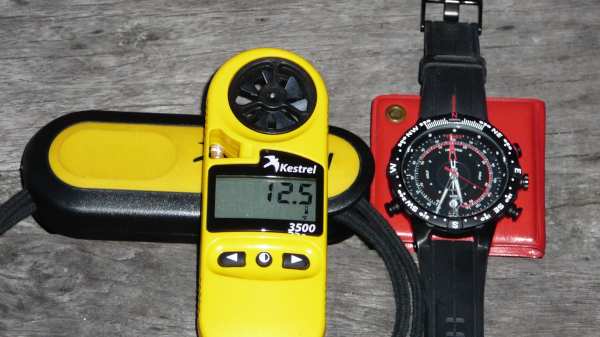 I have worn the watch on three Perth Bushwalking Club walks during this test period. They were all in the Darling Range which border the eastern edge of Perth, some 40 km (25 mi) from the sea. The average temperatures during the walks were 16 C (61 F) with occasional rain. Elevations fluctuated between 100 m to 240 m (328 ft to 787 ft). During the walks I would take a compass reading for magnetic north to orient myself with my map. The walks were this time all on tracks so there was no danger in getting lost. I just liked to work out where we as a group were, so that I could calculate as to how far we were from the planned stops for morning tea and lunch. I did not bother with the temperature readings during the walk as I was wearing the watch and my body heat affects the reading. When we stopped for the lunch breaks I took the watch off to let it cool down to the surrounding environment and took a reading out of interest. All of the creeks and streams were full of tumbling, flowing water from the rains and were not subject to tidal influence, so I did not bother with the tide function. My final day walk was around Eagle Hill helping with an introductory walk for people wanting to get involved in bushwalking. The majority of the walk was off-track so I kept using the compass function and temperature function to a). See where magnetic north was for navigation purposes, and b). To see how hot it was. Temperatures on this walk fluctuated between 21 C and 24 C (70 F and 75 F). There was no rain and the ground was very dry even though there had been good heavy rains a few weeks ago. Elevations fluctuated between 250 m and 480 m (820 ft and 1,575 ft). A cross section of the walk is below. 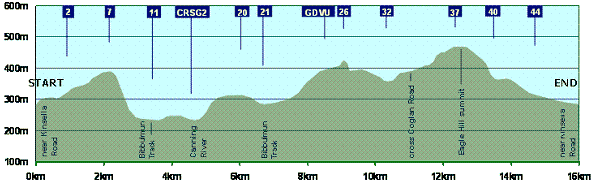 We went the opposite direction as set out on the above cross section, starting at the "End" and finishing at the "Start". Summary Apart from wearing the watch as a time piece during my working day, I used the watch on all of my bush walks for navigation purposes and temperature readings. I had very little use for the tide indicator apart from checking its accuracy against the Bureau of Meteorology as all of my walks were inland and away from tidal rivers. I found changing the time when moving from one time zone to another very easy to do without the instructions, apart from the initial setting. After that my memory bank kicked in without fail. The watch needed to be off my wrist for at least ten to fifteen minutes to fully adjust to the outside temperature and not be influenced by my wrist body heat especially when doing strenuous bush walking. In my job I use a lot of water and the watch was not in any way affected by being splashed by the water. However, the watch was not immersed in buckets of water. The battery is still powering on although the timepiece did lose a few minutes over a two month period. Currently it seem to be behaving itself as it is spot on when measured agaings the clock on my computer. Due to my eyesight, I need to wear glasses when reading, I found that I had extreme difficulty in reading any watch function in the dark using the INDIGLO night-light, so I always resorted to using a little key ring LED light to read the face. To date there has been no obvious wear and tear on the strap or face of the watch. The good and bad points still remain the same as in the Field Report. This report concludes the reporting series on the Timex Expedition E-Tide Temp Compass Watch. Thank you Timex for the opportunity to test this watch. Read more reviews of Timex gear Read more gear reviews by Ralph Ditton Reviews > Electronic Devices > Watches > Timex Expedition E-Tide Temp Compass > Test Report by Ralph Ditton | ||||