|
Osprey Argon 110 Backpack
Test Series by Raymond Estrella
LONG-TERM REPORT
August 12, 2008
CLICK HERE TO SKIP TO THE FIELD REPORT
CLICK HERE TO SKIP TO THE LONG-TERM REPORT
TESTER INFORMATION
|
NAME:
|
Raymond Estrella
|
|
EMAIL:
|
rayestrellaAThotmailDOTcom
|
|
AGE:
|
47
|
|
LOCATION:
|
Orange County, California, USA
|
|
GENDER:
|
M
|
|
HEIGHT:
|
6' 3" (1.91 m)
|
|
WEIGHT:
|
200 lb (90.70 kg)
|
I have been backpacking for over 30 years, all over California, and in many of the western states and Minnesota. I hike year-round, and average 500+ miles (800+ km) per year. I have made a move to lightweight gear, and smaller volume packs. I start early and hike hard so as to enjoy the afternoons exploring. I usually take a freestanding tent and enjoy hot meals at night. If not hiking solo I am usually with my wife Jenn or brother-in-law Dave.
INITIAL REPORT
The Product
Manufacturer: Osprey
Web site: www.ospreypacks.com
Product: Argon 110
Size: Large (also available in Medium and Extra Large)
Year manufactured/received: 2008
MSRP: N/A
Weight listed: 6 lb 13 oz (3.06 kg)
Actual weight 6 lb 11.6 oz (3.05 kg)
Volume: 6900 cu in (113 L)
Load weight capacity suggested: to 80 lb (36.3 kg)
Color: Delta Blue
Warranty: (from company web site), "Our lifetime warranty covers defects in materials and craftsmanship for the lifetime of the backpack. Products found to be defective will be repaired or replaced at the discretion of our Warranty Department."
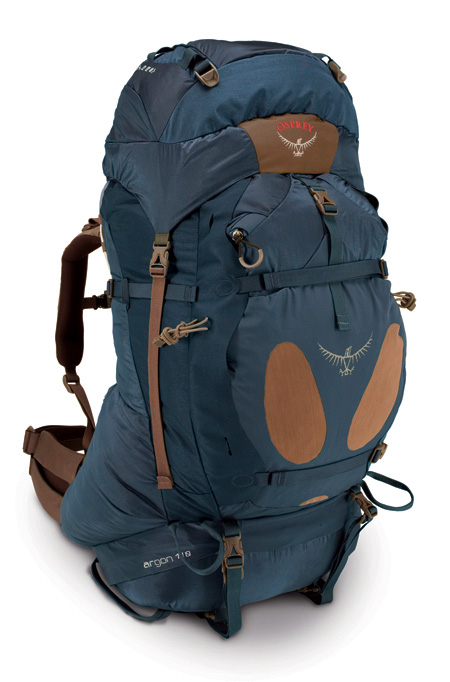 | | Image courtesy of Osprey |
Product Description
The Osprey Argon 110 pack (hereafter referred to as the Argon or the pack) is a blue with brown trim top-loading pack positioned by the manufacturer for use "the serious backpacker". I try to fit that bill.
The Argon came with a hang tag with an overview of the company's product lines. On the back were the pertinent details for the pack itself. Most the numbers above came from this, not the web site.
The front and back are 315D Cordura high tenacity nylon, while the bottom and sides are a heavier grid-type ripstop 330D x 210D high tenacity nylon. From the feel both types seem to be urethane coated on the inside.
At the top of the pack body is a 6 in (15 cm) extension sleeve. A cord runs around the top of the sleeve and through a sliding finger-pull cord lock, allowing the top to be drawn shut. Printed inside the sleeve is a Leave No Trace message printed in English and French. (Are they trying to tell us something?) Below the sleeve inside is a red internal compression strap running from the front of the pack to the back that allows the load to be snugged down.
While it is a top-loading pack it can also be accessed by means of the front panel zipper which hides under a weather flap on the right hand (when worn) side of the Argon. This zipper is double ended and is protected by the StraightJacket wing.
At the bottom of the main pack body is a sleeping bag compartment that has a nylon flap to create a shelf inside the pack. The shelf is not removable but it can be detached on one side from two buckles allowing it to fold down. This makes it a great sack, the type most of my packs are. The sleeping bag compartment can be accessed from the outside by way of a heavy duty zipper with double pulls. While the zipper is not waterproof it is protected from the elements by a big 2 in (5 cm) wide storm flap.
A removable hydration sleeve called the AquaSource ReCurve hydration pouch is made of 40D silnylon and connects to the internal backpanel of the pack utilizing a quick release male/female buckle system. Two ports allow the tube to be routed out of the pack on either side. The ports are large enough to allow the use of my insulated hydration tubes. The tube can be routed through a pair of stretch loops on each shoulder strap to keep it from flapping around.
Osprey says that the pouch can be carried on top of the pack too. But it can also be taken out of the pack and attached to the sleeping pad straps to turn it into a hydration pack for journeys away from the Argon 110.
On the front of the pack body is a huge storage pocket. It measures 18 x 10 in (46 x 25 cm) and is closed with a waterproof zipper that sits in a covered "garage" to keep water from coming in at the top. The pocket is roughly 2 in (5 cm) deep, but that can change depending on how much is in the main pack body as it can push inside too. A large stretch woven stuff-it pocket made of some blue stretchy material is over the storage pocket. It stuffs from the top and closes with a single quick connect fastener. The Osprey logo is emblazoned on it.
While wearing the Argon, on the right side of the pack at the bottom is a stretch woven pocket made of the same blue stretchy material. It accesses from either the top or a slash opening at the side. On the other side is a nylon pocket with an angled zipper that completely secures the contents. It has a bungee loop inside that can be used to keep a key ring.
At the bottom of the pack are two ice axe or tool loops. Below them and to the side a bit more are two larger tool loops. They are large enough to put most skis through, something that I really like to see.
There is a pair of removable external sleeping pad straps at the bottom of the pack.
Compression is handled by what they call the StraightJacket wings and straps. The wings are made of a double thickness of the heavy nylon. A bungee style tool keeper is on each one which can be positioned up or down by threading through the extra "button-hole" slots on the wings.
A removable top pocket/lid sits above the main pack body. The lid closes the body of the pack by the use of two short straps that run from the upper side-compression straps up to connectors on the lid. The lid turns into a fanny pack and has its own straps already connected to it. A cool detail is the ridged foam lumbar pad that may add to the comfort level and heat transfer while wearing it.
The lid is actually two separate pockets. A small one on the very top has a visible waterproof zipper. But hidden under a 1 in (2.5 cm) storm-flap is another double ended zipper that accesses the large main compartment. There is a key clip inside.
All of the zippers have nylon cord with curved plastic finger pulls that are large enough to fit a gloved finger into.
The ReCurve suspension is handled by an HDPE framesheet with dual 2024 AL 2/3 length, 20 mm (0.8") stays. Aluminum ReCurve rods on each side add stability and control. As I push down on the pack I can see these ReCurve rods flex. I wonder if it is meant to take some of the shock from the frame while pounding down a mountain with a full load?
The framesheet is covered by the AirScape backpanel with tri-section 10 mm ridged foam that is shaped to create a chimney that is supposed to let warm air from my back escape.
The BioForm A/X shoulder straps are made of dual density foam. The ergonomic shape of them has softer foam cutouts in the neck and armpit regions for added comfort with the denser areas of foam where durability and support are needed. The shoulder straps have two adjustment straps on them. The ones at the top of the shoulder adjust the distance the pack body rides away from my body. The one at the lower end of the shoulder strap pulls the pack down onto my shoulders changing the balance of weight between hip and shoulders. A sternum strap crosses the between the shoulder straps. It is mounted with sliders on a nylon strap to allow adjustment.
The BioForm CM A/X hip belt is constructed of dual-density EVA foam. The belt closes with a quick-connect buckle. It adjusts with the Osprey's ErgoPull system, a design that has the straps make a sideways V and tightens by pulling towards the center instead of away. They say, "It creates mechanical advantage to provide extra leverage in cinching down the hipbelt. The ErgoPull design also draws tension along the top and bottom of the belt, not through the center, so it distributes pressure more evenly over the padding and relieves direct pressure on the hipbones." As I have had it on four other packs I just say, "I like it!" The hip belt is custom moldable using the warming ovens at Osprey dealers to heat the belt and then let it cool while wearing to give an instant fit. Once cooled the foam stays formed to my hips cutting down on break-in time. I am going to get this done at my local REI.
FIELD REPORT
The Quick & Dirty Nitty Gritty
The Argon is a very comfortable pack with great load and volume handling capabilities. But the pockets, winter or 3-season, are lacking for my use. Find out the details by reading on…
Field Locations
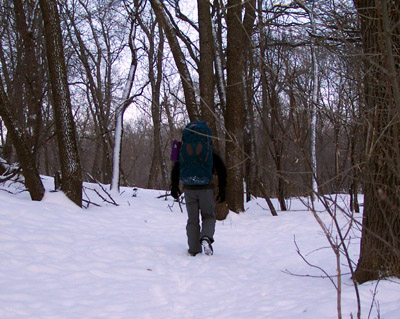
I used the Argon two times for overnighters in Minnesota. Once was at Maplewood State Park the other was at Buffalo River State Park. The temps there were between -3 and 8 F (-13 to -19 C) in snow from 5 to 12 in (13-30 cm) deep. Both trips were less than three miles in length and the total pack weight was only around 26 lb (11.8 kg). Below is a picture hiking down towards the frozen river.
I used it in San Jacinto State Park for a three-day trip. The lowest temperature was 22 F (-6 C) and I was in winds to 50 mph (81 km/h). I started with a pack weight of 52 lb (23.6 kg) but that was with snowshoes strapped on. They came off the pack and onto my feet 20 minutes into the hike.
The next two weekends Jenn and I used it together for over-nighters in the same area. We stayed at Round Valley at 9100' (2774 m) elevation, on snow again and with temperatures seeing highs of 33 F and low of 19 F (0 to -7 C) on the first, and temps from 25 F to near 50 F (-4 to10 C) on the second trip. Starting weight with snowshoes stored was 47 lb (21.3 kg).
Observations
Fitting: I took the Argon to my local REI (Recreational Equipment Inc.) store as they are an Osprey dealer and have an oven to heat the BioForm hipbelt. After heating for the proper temperature and time I put the hip belt on (off the pack at the time) and tightened the belt snugly around my waist. After 10 minutes the associate Chris told me it was ready to come off. He then put the belt on the pack for me and loaded it up with some weight and volume bags they have for the purpose of fitting, and had me put the pack on to adjust it to the right settings. I have to say that this was very helpful. I can adjust a new pack myself but it is a lot easier to have somebody else looking it over. Thanks Chris and REI!
After 11 days carrying the Argon I can say that it has been a great pack so far. I had one of the company's Aether packs and thought it was very comfortable (to 40 lb, 18 kg) but the Argon 110 blows it away. This pack is very comfortable. I hauled a very big load on a three-day winter backpacking trip on an unmarked route that saw us doing some hard distance through untracked snow. Because of a lot of extra climbing gear (helmet, shovel, crampons, ice axe, avalanche beacon, PLB, etc.) it pushed my weight above 50 lb (23 kg) when my snowshoes were strapped on. But the Argon handled it with no problem. Here is a picture bushwhacking (snow-whacking?) through the mountains.
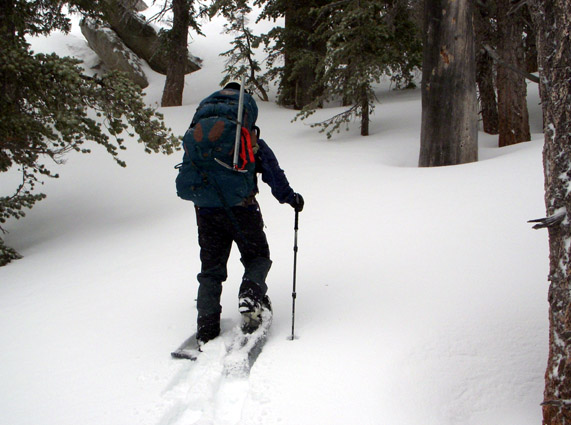
And one of the best things is that even with all that gear everything except my ice axe and helmet went inside of the pack. This makes it so much easier to maneuver since there is less to catch on branches (that get a lot closer when I am elevated by snow), rub against boulders, or just swing around throwing off my balance. At the beginning and end of the hike I had my snowshoes strapped on the pack also. I used the StraightJacket wings and straps for this purpose. They worked great.
The fitting that I got at REI turned out to be perfect. I did not have to adjust it at all after hiking under a real load. It is very easy to fine-adjust the balance between hip and shoulder. I tend to keep most of the Argon's weight on my hips as my legs are my strongest parts.
I used the hydration pocket for a 2 liter (2 qt) Platypus Hoser that I put inside of a Nalgene insulated bladder cover. I threaded the thick insulated Platy hose through the port and down through the loops on my shoulder pad. It worked very well. I also carried a 1 l/qt Nalgene bottle inside the pack at the top.
On the trip in Minnesota it was too cold for the bladder so I carried water in Nalgene bottles that were kept inside of Granite Gear Aquatherm insulated covers (see review). This is where my only gripe comes up with the Argon pack. I really do not like the side pockets. Neither of them will hold a covered bottle. As can be seen in the picture below the Field Locations I had to run a side compression strap through my bottle holder to have some water close to hand. (It is the purple thing on my left side.) But this lets it swing around, which is something I don't care for.
The zippered pocket is nice to keep things in that I don't want to lose. I ended up keeping my sun block, lip balm, and compass in it. The stretch pocket I used to stuff my gloves and hats in as I would switch items or take them off to regulate body temps. But I would much rather see two big normal pockets on the Argon.
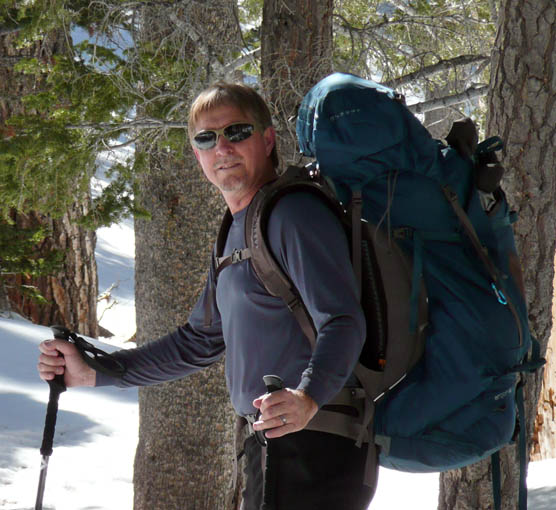
The Argon shined on the trips with Jenn too. I am getting ready for another trip to Mt Shasta and am trying to carry a lot of weight to prep for it. So I carried a lot of my wife's gear for her. In the picture below I have her 0 F (-18 C) sleeping bag and pad along with mine, the tent, huge 1st aid kit, stove, fuel, cookware and food, all inside of the Argon 110. It carried like a dream. We met a guy on our hike back out that recognized it and wanted to ask all about it. He could not believe what all I had inside of it. He was getting ready for a winter ascent of Whitney and needed a big pack. (So Roland, did you get an Argon?) Here is a picture of it loaded for two.
The Argon is so roomy, when I hike with just my own loads (without the climbing gear) I did not bother using a compression sack for my sleeping bag. I kept the bag in the cotton storage sack and put it into the bottom of the Argon. Then I put the tent on top of that followed by everything else. I just let the bag compress itself as needed under the load which let me keep a full pack without having the droopy-diaper effect. It backfired on one trip because I had snow everywhere and had to put wet or soon-to-be wet (as the snow melted) gear on my unprotected bag. Doh!
As winter is now over (much like this installment of my report) I do not have many plans for the Argon as my summer loads will be ridiculous in it. (Time to go back to Osprey's awesome Talon packs.) But I am taking some trips right before the test ends that will see me carrying multiple tents and gear for two or three people. Read on to see "how that worked out for me…" (A nod to the nor'easterners, please add accent.)
LONG-TERM REPORT
Field Locations
Jenn and I went to Limber Pine Bench in the San Gorgonio Wilderness for an overnighter. The trails were fine, dirt and rock, until just above 8500' (2590 m) where we started hitting lingering snow. Temps were from 67 F to 40 F (20 to 4 C) with enough wind to keep the mosquitoes away. We had 3680' (1122 m) of elevation gain in 6 miles (9.6 km) and a total of 12 miles for the trip (19.2 km). I started with a 41 lb (18.6 kg) pack weight.
I used it on a hike with my children Emma and Ray to San Jacinto State Park. This was only a six mi (10 km) hike with 300 ft (100 m) of elevation gain but I carried a lot of gear, including my biggest three person tent and a soft-sided cooler. The weight was over 50 lb (22.7 kg).
We also went to Itasca State Park, the birthplace of the Mississippi River where we got a permit for one of three sites at Myrtle Lake.(Backpacking sites are issued, a new one for me.) This four mile (6 km) round trip hike was on easy terrain as it is almost all grass, at the worst dirt. I carried a big pack as I brought lots of creature comforts as well as cold pizza for my picky eater son… Temps were from 64 to 80 F (18 to 27 C) at an elevation of 1500 ft (460 m).
I took Emma and Ray on a three-day backpacking trip to Maplewood State Park in Minnesota. We stayed at the Beers Lake Backpacker site the first day and at the Grass Backpacker site the second. The weather was great for two days then rained the last. The temperatures were from 79 down to 61 F (44 to 34 C). We backpacked for 6 miles (10 km) with another few miles (5 km) of exploring. The elevation was 1340 ft (408 m) above sea level. My pack was near 50 lb (22.7 kg) starting out.
Observations
With winter over the only real use I had for the Argon 110 was playing Sherpa for my wife and children. A good example is the trip to Limber Pine Bench with Jenn. I knew the distance was not going to be bad and decided to make a comfort trip out of it for us. I carried a three-person tent, Jenn's 15 F (-9 C) bag and Therm-a-Rest Trail Comfort pad and chair kit, along with my 20 F (-7 C) bag, pad and sit pad. Plus, I had a down coat for each of us as the forecast was possibly to freezing with wind.
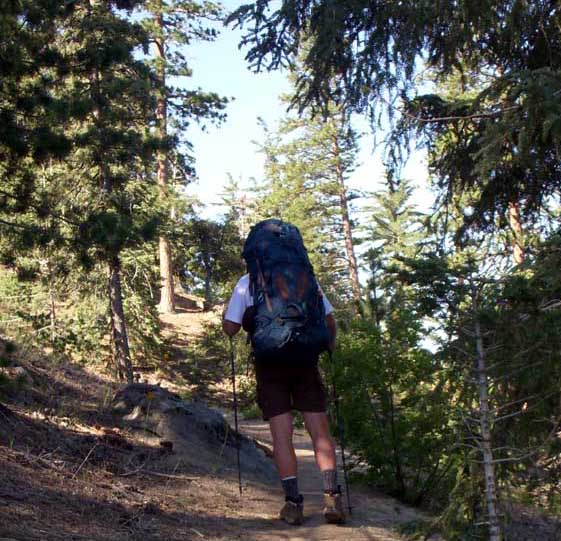
Add to this the stove, fuel, two-piece pot set, big first-aid kit, extra clothes and all the normal things that accompany me on a hike and this made for the highest volume load to date. And for the first time I had to really use the extension sleeve, mainly because of the tall tent and Therm-a-Rest Trail Comfort pad. But the Argon still swallowed everything. I had nothing outside of the pack. Here is a picture of it on the climb up to the camp site.
It carried very well. I think I like the hip belt better than the shoulder straps. Not that the straps are lacking by any means, just that as a person that has used many Osprey packs (and many, many other packs), the new BioForm hip belt is my favorite part. I do wish that they could figure a way to get some little incidental pockets on it. Their Talon packs (I own three and use them a lot) have spoiled me with the easy access to things like lip balm, sun block, snacks, etc.)
I was going to complain that the red internal compression strap running from the front of the pack to the back, that allows the load to be snugged down and away from the back of my head, was not long enough when I finally needed to use the sleeve extended. I carried my load up the mountain with a little bulge hitting me in the head. As I was loading up for the return trip I had another "Doh" moment. (I thought God would cut me some slack as I got older, at least from having to admit it. Oh well, I volunteered for this.) I needed to load it to the normal level, or (as I worked out as I played with it in camp) just above, and then attach the internal compression strap, pulling it snug. Then, and only then, I add extra gear to the pack body in the extension sleeve. If the pack is adjusted correctly (and it is for me) it won't matter if the extra load makes the body push a bit outward, as the strap has sucked it away from my noggin.
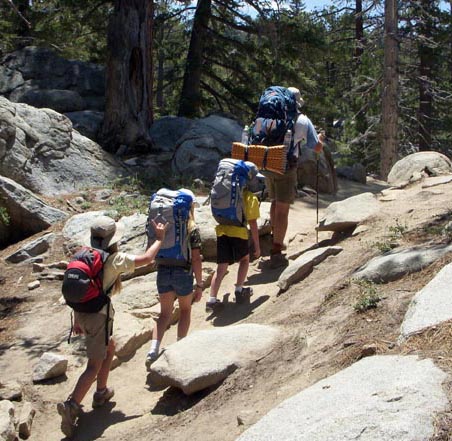
On the trips with my children I carried two Z-Lite sleeping pads on the external pad straps. They worked great. I also carried their water bottles attached to Aqua-Clips hooked to the middle compression strap loops at the back of the pack to allow them to pull them off and drink at will. These can be seen in the picture below. Ray and Emma thought it was pretty cool to have Osprey packs like dad, but neither wanted to carry mine…
And I am sorry to say that even leaving winter behind, with its need of roomy spacious side pockets; I just do not care for the side pocket scheme of the Argon. The shape and difficult access to the zippered left pocket is so weird that I ended up using it for snacks only. I carried my trowel and camera in the stretch pocket, and would shove my hat in once in a while, or a Larabar wrapper or two. I found that items would migrate out of this stretch pocket, especially as the volume in the pack got up there to put internal pressure on the contents.
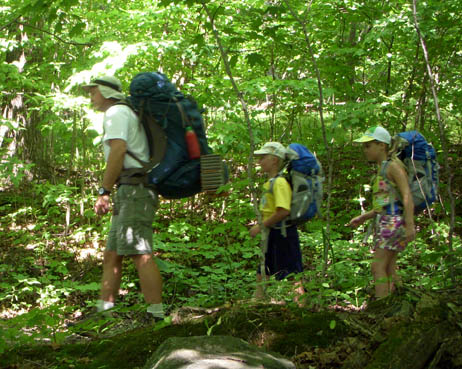
I very much enjoyed using the Argon 110. While it was larger than I needed (or expected, as I was to test the Argon 85) I had fun going back to the big loads of yesteryear and having the most comfortable platform I have ever worn. I thank Osprey and BackpackGearTest.org for letting me wear it all over my beloved mountains.I leave with a picture from our Maplewood State Park trip.
This report was created with the BackpackGearTest.org Report Writer Version 1.
Copyright 2008. All rights reserved.
Read more reviews of Osprey gear
Read more gear reviews by Ray Estrella
|