|
REI ARETE ASL 2 TENT
TEST SERIES BY BRIAN HARTMAN
LONG-TERM REPORT
March 15, 2012
CLICK
HERE TO SKIP TO THE FIELD REPORT
CLICK
HERE TO SKIP TO THE LONG-TERM REPORT
TESTER INFORMATION
| NAME:
|
Brian Hartman
|
| EMAIL:
|
bhart1426ATyahooDOT com |
| AGE:
|
44
|
| LOCATION:
|
Westfield,
Indiana |
| GENDER:
|
M
|
| HEIGHT:
|
5' 9" (1.75
m) |
| WEIGHT:
|
145 lb (65.80
kg) |
I have been hiking and camping
for over 20 years and enjoy backpacking solo and with my kids in Scouting. I
especially enjoy fall and winter backpacking and camping. My backpack and gear
are older and weigh 40+ lbs (18 kg). This has limited the distances I have been
able to cover while hiking. My goal over the next several years is to replace
my existing clothing and gear with more suitable and lighter weight
alternatives.
INITIAL REPORT
PRODUCT INFORMATION &
SPECIFICATIONS
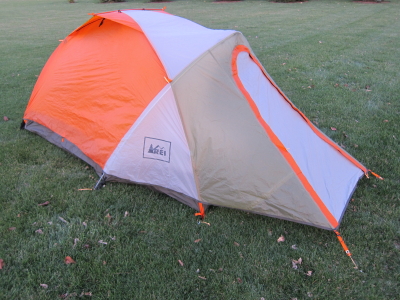 |
| REI Arete ASL 2 with rainfly |
Manufacturer: REI
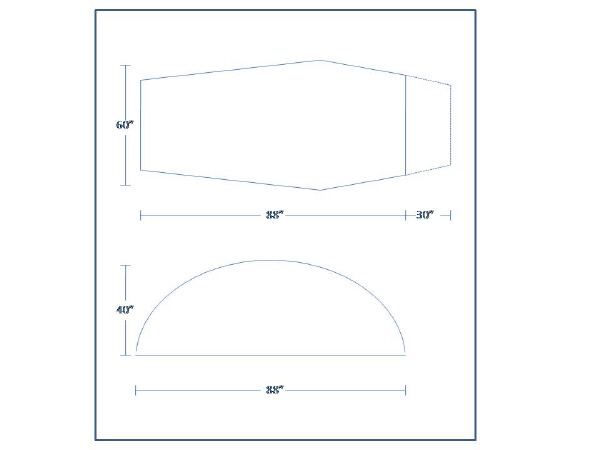 |
| Tent footprint |
Year of
Manufacture: 2011
Manufacturer's Website: http://www.rei.com/
MSRP: US $299
Listed
Weight: 5 lb 14 oz (2.67 kg)
Measured Weight: 6 lb (2.70 kg)
Color: Lichen
/ Liquid Orange
Other details:
Two person 3-4 season backpacking
tent.
Floor dimensions: 88 x 60 inches (224 x 152 cm)
Floor area: 32.5
square feet (3.02 meter squared)
Vestibule area: 8 square feet (0.74 meter
squared)
Peak Height: 40 inches (102 cm)
Number of Doors: 1
Number of
Poles: 3 + 1 vent
Pole Material: Aluminum DAC Featherlite NSL
Pole
Diameter: 9.6/9.0 millimeters (3.8/3.5 inches)
Canopy Fabric:: Ripstop
nylon/mesh
Floor Fabric: Coated nylon taffeta
Rainfly Fabric: Coated
ripstop nylon
Packed Size: 6 x 20 inches (15.2 x 50.8 cm)
As
described on REI's website, "the Arete ASL (All Season Light) 2 tent fills the
gap between the limited seasonality of ultra light tents and the robustness of
4-season tents." In practical terms, the Arete 2 is a three pole, double-wall,
extended dome tent with a compact footprint and a single front vestibule and
door.
INITIAL IMPRESSIONS
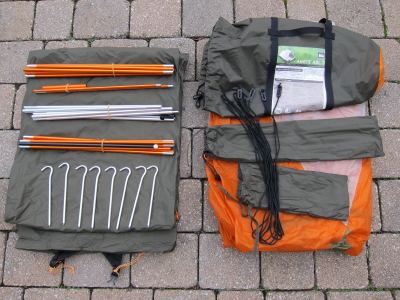 The tent arrived in excellent condition and when I opened the shipping box my
initial reaction was excitement as I saw the compact size of the stuff sack,
measuring only 6 x 20 inches (15.2 x 50.8 cm). I was also struck by its light
weight which is usually not something I associate with 4-season tents. Almost
immediately thereafter, my attention was drawn to the compression straps on the
outside of the stuff sack and the setup instructions and list of contents which
REI had posted there as well. Needless to say, my initial impressions were
positive and I was looking forward to opening things up. As I removed
everything from the stuff sack, the list of contents included the following
items:
The tent arrived in excellent condition and when I opened the shipping box my
initial reaction was excitement as I saw the compact size of the stuff sack,
measuring only 6 x 20 inches (15.2 x 50.8 cm). I was also struck by its light
weight which is usually not something I associate with 4-season tents. Almost
immediately thereafter, my attention was drawn to the compression straps on the
outside of the stuff sack and the setup instructions and list of contents which
REI had posted there as well. Needless to say, my initial impressions were
positive and I was looking forward to opening things up. As I removed
everything from the stuff sack, the list of contents included the following
items:
- Tent body and rainfly
- 3 main poles and 1 vent pole
- 1
pole-repair tube
- 8 aluminum stakes with small storage sack
- 4 guylines
with tighteners
- 1 pole sack
- 1 main compression stuff sack
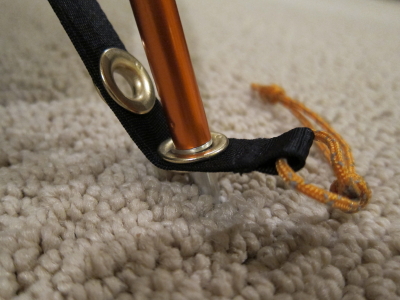 |
| webbing strap with grommets |
Materials and Construction: As I began setting up the tent in my family
room, I took the opportunity to review the construction of the Arete 2 and was
happy to see excellent workmanship throughout the tent. All of the stitching
was precise with no loose threads. Vital seams were meticulously sealed and all
of the zippers worked perfectly. In my opinion, just as poor workmanship can be
a warning sign of upcoming trouble, good workmanship is often the sign of a
well-made product which will last for years. The tent body is constructed of
ripstop nylon while the floor consists of a coated nylon taffeta. The tent
floor has a hybrid design that combines sealed seams with a bathtub style floor
that wraps eight inches (20 cm) up the sides of tent to keep water outside. As
noted on REI's website, an optional floor saver is available to help reduce wear
and tear on the tent floor. In fact, I use a floor saver on my eight man tent
and it has without a doubt prolonged the life of that tent. Moving on, the
rainfly is made of a siliconized 30-denier ripstop nylon with "no-wick" welded
construction at the guy-out points, pole wraps and zippers. The rainfly also
has tape-sealed seams for additional waterproofness. When the rainfly is
attached, it creates a vestibule at the front of the tent with dimensions of 24
x 30 inches (61 x 76 cm).
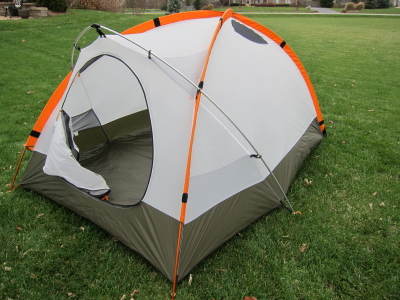 The tent frame consists of three lightweight, collapsible DAC aluminum poles.
The tent poles are color coded for easy assembly. The two main poles slide into
dead-end pole sleeves for quick setup. The other ends of the two main poles
attach to grommets located in webbing straps on the front corners of the tent.
By incorporating a third pole into their design, REI has created a tent with
steep and straight walls as well as a high ceiling for more usable space than
would be possible in a two pole tent. The third pole stretches the sides of the
tent to create additional room in the front of the tent at the head and shoulder
area. In addition, adding the third pole to the structure seems to add a lot of
strength and rigidity to the tent. To the left is a photo of the tent with the
rain cover off to show how the tent poles are arranged.
The tent frame consists of three lightweight, collapsible DAC aluminum poles.
The tent poles are color coded for easy assembly. The two main poles slide into
dead-end pole sleeves for quick setup. The other ends of the two main poles
attach to grommets located in webbing straps on the front corners of the tent.
By incorporating a third pole into their design, REI has created a tent with
steep and straight walls as well as a high ceiling for more usable space than
would be possible in a two pole tent. The third pole stretches the sides of the
tent to create additional room in the front of the tent at the head and shoulder
area. In addition, adding the third pole to the structure seems to add a lot of
strength and rigidity to the tent. To the left is a photo of the tent with the
rain cover off to show how the tent poles are arranged.
Eight aluminum
stakes are provided with the tent. Since this is probably the minimum necessary
to secure the tent in gusty weather, I will likely add more stakes so that I can
utilize the extra guy-lines that were supplied in the stake bag.
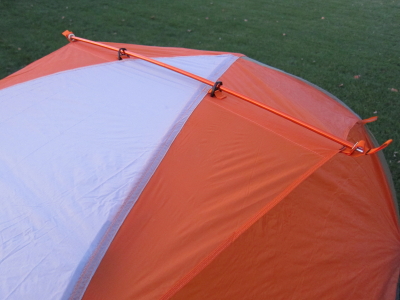
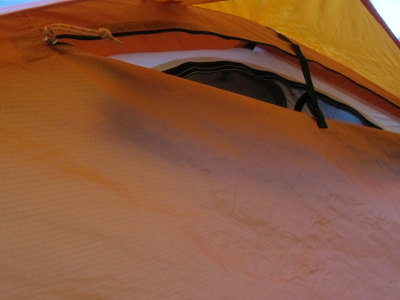
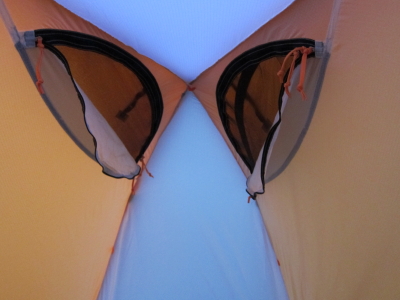
The
Arete 2 has a single mesh door with a zippered nylon panel that can be used in
conjunction with the two ceiling vents to allow air flow inside the tent to
reduce condensation. The ceiling vents are fully adjustable from inside the
tent and can help create additional cross-flow ventilation. The following three
photos show a) the vent pole which opens the outside vent flaps, b) the vent
hole as seen from outside the tent, and c) the ceiling vents as seen from inside
the tent. Because the vents are zippered on the inside, I can reach my hand
through them to seal off the opening in the rainfly while still inside the tent.
This will come in useful when it starts raining sideways in the middle of the
night.
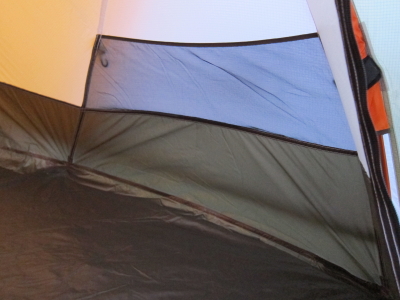
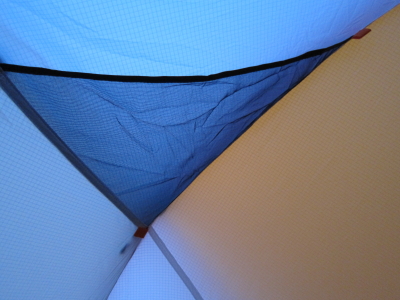
The
Arete 2 has multiple storage options for keeping essential items handy including
two corner pockets, two roof pockets and a door pocket that can also be used to
hold the door out of the way. There are also several hang loops inside the tent
for securing additional items. The mesh corner pockets are located adjacent to
the door and opposite of each other on either side of the tent. The corner
pockets are 5.5 x 16 inches (14 cm x 40 cm) while the roof pockets are 6 x 7
inches (15 cm x 18 cm). They provide plenty of room for a flashlight, glasses,
GPS and any other items that may want to be kept off the tent floor.
 |
| Corner pockets |
 |
| Roof pockets |
READING THE INSTRUCTIONS
As mentioned earlier, the setup
instructions are printed on a piece of fabric which is sewn to the main stuff
sack. The instructions describe how to pitch the tent and rainfly in twelve
easy steps. Three small drawings provide additional details. The pitching
instructions are well-written and straightforward. Similar to other dome-style
tents, the Arete 2 tent body can be staked down before erecting the poles and
pitching the tent. This is very helpful in windy conditions that would
otherwise make pitching the tent quite difficult. A small hang tag was attached
to the outside of the main stuff sack that briefly mentioned DAC, who is the
manufacturer of the aluminum poles for this tent. Finally, a single instruction
sheet was tucked in the stake bag; on it were printed tent maintenance
instructions and a few helpful hints. A few noteworthy points are detailed
below (paraphrased):
- Prevent mildew growth by drying the tent
thoroughly before storage. Heat damages the coatings so avoid storing the tent
in hot trunks.
- A pole-repair tube is included and can be used to
temporarily repair a pole that has broken in the field. Tape the broken pole
first and then slide the tube over the broken section before taping again.
-
Hand-wash the tent using a sponge and mild, nondetergent soap to remove dirt and
debris from the rain fly and floor of the tent. Kerosene can be used to remove
pitch or grease.
- Zippers can be coated with a silicone lubricant as needed
to prevent jamming and keep them sliding freely. Pole ferrules can also be
coated with silicone lubricant to allow them to engage more easily.
- Fold
poles at the center, rather than section by section to prevent unnecessary
stress on the shockcords.
TRYING IT OUT
  It was quite breezy the day I set up the Arete 2, so being able to stake the
tent out ahead of time made things much easier. The two main poles were easy to
assemble and slide into the continuous pole sleeves. I then inserted the tip of
each pole into the outermost grommet in the webbing tabs that are located in the
front tent corners. At this point, roughly 4 minutes into my setup, the tent
was freestanding. The next step was to secure the silver pole into the grommets
in the webbing tabs on either side of the tent. This was easily completed.
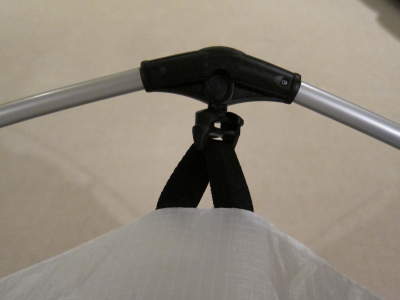
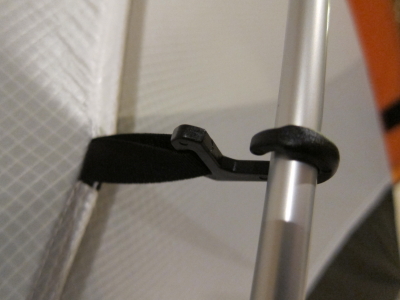
Next, I connected the strap above the tent door to the black attachment point at
the peak of the silver pole and then worked my way down either side of the tent
hooking the clips to the pole. Finally, I laid the rain fly over the tent and
clipped it at each corner. I used the last two stakes to secure the front
vestibule. My overall setup time was approximately eight minutes. I can probably
reduce this by a minute or so as I become more familiar with the tent.
It was quite breezy the day I set up the Arete 2, so being able to stake the
tent out ahead of time made things much easier. The two main poles were easy to
assemble and slide into the continuous pole sleeves. I then inserted the tip of
each pole into the outermost grommet in the webbing tabs that are located in the
front tent corners. At this point, roughly 4 minutes into my setup, the tent
was freestanding. The next step was to secure the silver pole into the grommets
in the webbing tabs on either side of the tent. This was easily completed.
Next, I connected the strap above the tent door to the black attachment point at
the peak of the silver pole and then worked my way down either side of the tent
hooking the clips to the pole. Finally, I laid the rain fly over the tent and
clipped it at each corner. I used the last two stakes to secure the front
vestibule. My overall setup time was approximately eight minutes. I can probably
reduce this by a minute or so as I become more familiar with the tent.
I
really like the easy setup of this tent and am looking forward to trying out the
speed pitching option which allows the tent and rainfly to be semi-permanently
attached for a quick setup that protects the canopy from
precipitation.
SUMMARY
The REI Arete 2 ASL tent is
distinctly lightweight for a 4 season tent and yet from my initial testing it
appears to be very well-built and quite sturdy! Notwithstanding its lightweight
design, REI has managed to include a lot of nice features with this tent like
the storage pockets, respectably sized vestibule and full nylon body
construction. I am looking forward to the next four months of backpacking with
this tent.
This concludes my Initial Report for the REI Arete ASL 2 tent.
I will post a Field Report in approximately two months. Please check back then
for further information.
FIELD
REPORT
FIELD LOCATIONS AND CONDITIONS
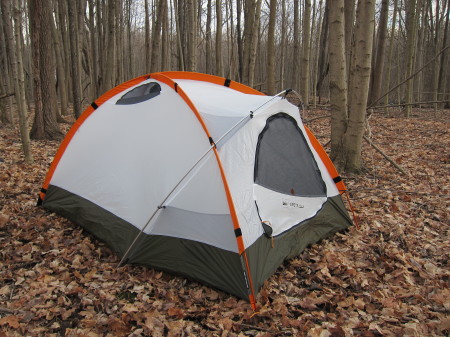 During the past two months I used the Arete 2 on three trips for a total of 6
nights. My first trip was an over-night backpacking trip to the Charles Deem
Wilderness in the Hoosier National Forest just outside of Bloomington, Indiana.
The elevation was 750 ft (228 m) and temperatures ranged from 39 to 50 F (4 to
10 C). I stayed mainly on established trails during this 9.8 mile (15.8 km)
hike due to muddy conditions although I ventured off-trail to explore around my
campsite in the evening. The wind was gusty during this trip and skies were
generally overcast. My second trip was a three day trip to Devil's River in
Manitowoc, Wisconsin. This rail trail was 14.2 miles (22 km) long as it wound
through farmlands, prairies and wetlands. Temperatures were in the upper 20's
to low 30's F (-2 to 3 C) and there were intermittent flurries. My third trip
was a three day backpacking trip to Brown County State Park. Elevation was 780
ft (238 m) and temperatures ranged from a high of 34 F (1 C) during the day to
22 F (-5 C) at night. I shared the tent with my son on this trip.
During the past two months I used the Arete 2 on three trips for a total of 6
nights. My first trip was an over-night backpacking trip to the Charles Deem
Wilderness in the Hoosier National Forest just outside of Bloomington, Indiana.
The elevation was 750 ft (228 m) and temperatures ranged from 39 to 50 F (4 to
10 C). I stayed mainly on established trails during this 9.8 mile (15.8 km)
hike due to muddy conditions although I ventured off-trail to explore around my
campsite in the evening. The wind was gusty during this trip and skies were
generally overcast. My second trip was a three day trip to Devil's River in
Manitowoc, Wisconsin. This rail trail was 14.2 miles (22 km) long as it wound
through farmlands, prairies and wetlands. Temperatures were in the upper 20's
to low 30's F (-2 to 3 C) and there were intermittent flurries. My third trip
was a three day backpacking trip to Brown County State Park. Elevation was 780
ft (238 m) and temperatures ranged from a high of 34 F (1 C) during the day to
22 F (-5 C) at night. I shared the tent with my son on this trip.
PERFORMANCE IN THE FIELD
During my past two months of
testing, the REI Arete ASL 2 tent was fairly quick to pitch. Once I found a
good method for installing the main poles, the tent was straight forward and
relatively easy to set up in both windy conditions and in the dark. Most nights
I could pitch the tent within seven minutes. When my son and I camped together
we were able to set up the tent in just under five minutes. Of course, with all
tents that have continuous pole sleeves, the Arete 2 can be challenging for one
person to set up. The reason is that the two main poles carry the weight of the
entire tent body while it's being raised. Consequently, it was hard to exert
enough force on the pole ends to bend them upward without some help. It was
also challenging to get the poles into their grommets because the tent body was
constructed slightly smaller than necessary to allow for fabric stretch. I
found the easiest way to pitch this tent was to flip it on its side while
pushing on the main poles. This seemed to work better because I was no longer
fighting the weight of the tent body while trying to bend the poles. Once I
secured the first pole in its grommet, completing the rest of the tent was easy.
Well, sort of. After two months of use I still have trouble installing the
vent pole as it requires a lot of force to snap it in place. Unfortunately
getting the poles in place usually required me to remove my gloves for extra
grip. Not something I looked forward to in winter. In regards to tear down of
the tent, it was straight forward and somewhat quicker than assembly. I really
like that the tent stuff sack is generously sized. Not once did I have to
reroll the tent to squeeze it into the stuff sack. In addition, the compression
straps allowed me to compact it enough to easily fit in my backpack.
When I first read about the speed pitching feature, I was really
excited. It's a great idea in concept and has two practical benefits: 1) faster
setup and tear down and 2) it prevents the tent body from getting wet when it is
pitched in rain. After my first trip, I left the rain fly secured to the tent
body so I could speed pitch the tent my next time out. However, I was not
successful in speed pitching the tent on my next outing as I simply couldn't
erect the main poles without the help of someone holding up the tent in the
middle.
REI did a great job designing the inside of the Arete 2. The
floor space is laid out efficiently and the high angled walls and 40 in (102 cm)
ceiling create ample sitting room. For solo use the Arete 2 provided plenty of
room. While backpacking alone, I kept all my gear in the tent with me and still
had enough room to maneuver around inside. My gear typically included my
backpack with supplies, an open cell sleeping pad, and a 20 F (-6 C) sleeping
bag. While in the tent, I could easily unpack and arrange my supplies, get
dressed, and stretch out while sleeping. My teenage son and I slept together in
the Arete 2 one weekend and it was tight but not unmanageable. The tent is
designed with additional room at the shoulder area for two people to sleep side
by side with their heads towards the door of the tent. With two sleeping bags
laid out, most of the floor space was taken up but there were still numerous
mesh pockets to store items off the floor. The storage pockets came in handy
for stashing my watch and glasses while the gear loop provided a great place to
hang my lantern. I also really liked that the pocket on the front of the tent
could be used to stash the door when it was opened. Although there was only one
door on the tent, I did not find it a problem when two people were sharing the
tent.
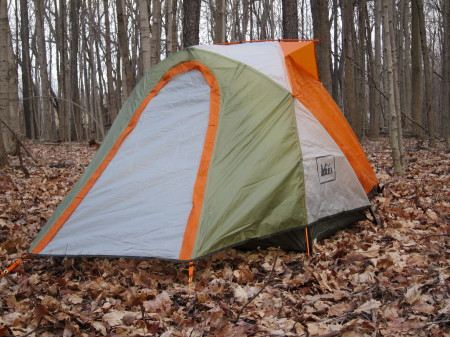 Although the vestibule provided additional room to leave some items outside
while still protected from the weather, it was not very large and any items
placed there prevented entry and exit from the tent. After bringing my boots
and backpack into the vestibule there wasn't much room for anything else unless
I wanted to step on it while trying to get into and out of the tent. In this
regard, having two people in the tent was a problem because most of the gear had
to go in the vestibule. This made getting into and out of the tent quite
difficult. Because the vestibule was narrow and the roof was fairly low I did
not attempt to cook in it.
Although the vestibule provided additional room to leave some items outside
while still protected from the weather, it was not very large and any items
placed there prevented entry and exit from the tent. After bringing my boots
and backpack into the vestibule there wasn't much room for anything else unless
I wanted to step on it while trying to get into and out of the tent. In this
regard, having two people in the tent was a problem because most of the gear had
to go in the vestibule. This made getting into and out of the tent quite
difficult. Because the vestibule was narrow and the roof was fairly low I did
not attempt to cook in it.
During my testing, the Arete 2 had no major
issues with condensation despite the fact that it used nylon fabric instead of
mesh for the tent walls. The ceiling vents allowed moist air to exit the tent
and the front door had a mesh interior that could be opened to allow air into
the tent. I noticed a thin layer of ice crystals inside the tent one brisk
morning but I actually expected it to be more noticeable.
So far I only
encountered one day of heavy rain but during this time I did not notice any
leaks in the tent floor or rain fly. REI wisely incorporated sealed seams, a
bath tub floor and double wall design into this tent for proven reliability. I
no longer worry about my sleeping bag touching the tent walls as everything has
stayed completely dry. The day it rained, water beaded up nicely on the rain
fly and it stayed taut despite the downpour.
The Arete 2 has performed
very well so far in terms of durability. The tent hasn't seen heavy snow but it
has been subjected to heavy winds, driving rain and below freezing temperatures.
The tent's three pole design stood up well in heavy winds and showed no signs
of giving in. In addition, the tent floor was subjected to sticks and other
pointed objects that were hidden under leaves and snow with no ill effects. The
tent fabric showed no signs of wear or damage and the zippers continued to work
smoothly. The tent poles and tent stakes have also fared well except for two
stakes that bent in the frozen ground. Because the tent has not experienced a
major snow fall so I can't speculate at this point on how it would handle the
load but I do expect there would be some snow accumulation due to the relatively
large flat spot on top of the tent.
SUMMARY
The REI Arete ASL 2 tent has
performed very well during the past couple of months. It is lightweight, easy
to set up and has enough floor space for two people with plenty of headroom.
The vestibule is not huge but it provides adequate storage for essential gear.
The tent's three pole design and ripstop nylon body offer strength and rigidity
in windy conditions and I have had no problems with condensation thanks to the
ceiling vents. So far this tent appears to be well suited for winter
weather.
This concludes my Field Report for the REI Arete ASL 2 tent.
Please check back in two months for my Long Term Report and further test
results.
LONG-TERM
REPORT
LONG-TERM TEST LOCATIONS AND
CONDITIONS
During the past two months I used
the REI Arete ASL 2 tent on two backpacking trips totaling four nights. The
weather during this time period was mild with daytime highs just over 70 F (21
C) and lows in the upper 40's F (9 C).
1. My first trip was to Mound
State Park in Indiana. Daytime temperatures during this two night backpacking
trip approached 66 F (19 C) while nighttime temperatures dropped to 48 F (9 C).
The weather both days was mostly cloudy with light winds and intermittent
showers. The terrain was hilly and trails were muddy but I was able to pitch the
tent both nights on relatively flat, dry ground. I hiked 11 miles (17 km) over
the course of this trip. Elevations ranged from 550 ft (168 m) to 730 ft (223
m).
2. My second trip was near the town of Oldenburg in southeastern
Indiana. During this two night outing I hiked mostly off-trail through woods
and farmland several miles outside of town. I covered 9.5 miles (15.28 km)
across moderately hilly terrain while temperatures ranged from 72 F (22 C) to 55
F (13 C). I pitched the tent in flat, wooded areas both nights.
PERFORMANCE IN THE FIELD
The Arete ASL 2 performed very
well during the past two months of testing. During this time it was durable,
relatively easy to set up despite a few annoyances, and provided satisfactory
accommodations for a sleeping partner for two nights.
Performance: The
Arete did a great job of keeping me warm and dry on all of my backpacking trips.
The nylon tent body retained my body heat while letting moisture escape through
the roof vents so that condensation was never a problem. On the coldest nights
I felt much warmer than when using my three season tent which has a mesh tent
body. During my testing, I almost always left the roof vents open, and never
had a problem with a wet sleeping bag in the morning. In addition to staying
warm, the Arete stayed completely dry in wet conditions. There were no leaks in
the tent and I found that the few times my sleeping bag touched the tent walls,
I never experienced water penetration.
Durability: I had no problems or
excessive wear issues with the tent body, rainfly, poles, zippers, or any other
components during this test period. The tent withstood heavy winds and rain
with no issues whatsoever thanks to its rugged three pole design and full nylon
body. Unfortunately, this was a mild winter and so I could not comment on the
Arete's ability to handle a heavy snowfall or extreme winter
temperatures.
Setup: I had no major problems setting up the tent during
this test period. As mentioned in my Field Report, the tent fabric eventually
seemed to loosen up and that made it easier to pitch the tent. The only pole
that continued to give me problems was the ventilation pole which remained
difficult to install and remove barehanded and nearly impossible to do with
gloves on. I found that if I applied enough force to the pole to bend it upward
in the middle I could eventually secure or remove it. Despite my concern that I
might break this short pole by all the stress I put on it, so far it has held up
well. One other area where I struggled was with the speed pitching option.
After two more attempts using this feature, I finally gave up as it simply
wasn't saving me any time and actually made pitching the tent more difficult
without a second set of hands to help out.
Space: The Arete provided
plenty of space while camping solo but remained just adequate when used as a two
person tent. This was mainly due to the limited floor and vestibule space that
was available for gear when two people were sharing the tent. Obviously this
would not be as big of a problem in summer as in winter when more backpacking
gear and supplies are typically brought along on trips. When sharing the tent
with a sleeping partner, we found it difficult to fit two pair of boots and
backpacks in the vestibule area and still have room to get into and out of the
tent. On the plus side, there seemed to be adequate shoulder room inside the
tent for two average sized adults lying side by side.
SUMMARY
The REI Arete ASL 2 is well
constructed and quite sturdy with its three pole design. It is a great
lightweight alternative to heavier four season tents for moderate winter
conditions. It has performed very well during this test period and has earned a
top spot among my backpacking equipment.
This concludes my long term
report and this test series. I would like to thank REI and BackpackGearTest.org
for the opportunity to test the this tent.
This report was created
with the BackpackGearTest.org
Report Writer Version 1. Copyright 2012. All rights reserved.
Read more reviews of REI gear
Read more gear reviews by Brian Hartman
|