|
Big Agnes Insulated Air Core Pad
By Raymond Estrella
OWNER REVIEW
February 05, 2009
TESTER INFORMATION
|
NAME:
|
Raymond Estrella
|
|
EMAIL:
|
rayestrellaAThotmailDOTcom
|
|
AGE:
|
48
|
|
LOCATION:
|
Orange County, California, USA
|
|
GENDER:
|
M
|
|
HEIGHT:
|
6' 3" (1.91 m)
|
|
WEIGHT:
|
200 lb (90.70 kg)
|
I have been backpacking for over 30 years, all over California, and in many of the western states and Minnesota. I hike year-round, and average 500+ miles (800+ km) per year. I have made a move to lightweight gear, and smaller volume packs. I start early and hike hard so as to enjoy the afternoons exploring. I usually take a freestanding tent and enjoy hot meals at night. If not hiking solo I am usually with my wife Jenn or brother-in-law Dave.
The Product
Manufacturer: Big Agnes Inc 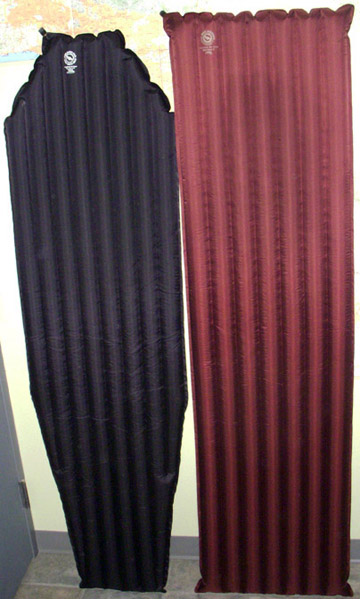
Web site: www.bigagnes.com
Product: Insulated Air Core Pad
Size: Rectangular, Long
Year manufactured: 2008
MSRP: (US) $84.95
Weight listed: 27 oz (765 g)
Actual weight: 26.3 oz (746 g)
Weight of stuff sack w/ repair kit: 1.4 oz (40 g)
Measurements listed: 20 x 78 x 2.5 in (51 x 198 x 6.25 cm) Verified accurate
Packed size listed: 5.5 x 9 in (14 x 23 cm) Verified accurate
Estimated R-value: 4.1
Temperature rating: to 15 F (-9 C)
Product Description
The Big Agnes Insulated Air Core Pad (hereafter referred to as the IAC or the pad) is an inflatable air mattress intended for use as a cool weather backpacker's sleeping pad. The pad is made of brown 50D nylon diamond rip-stop on top, with the same material in black on the bottom. The inner surface of the nylon has been given a polyurethane coating. The IAC has the Big Agnes logo at the upper left corner of the pad in white lettering, along with the product name and size. Just below that is a Primaloft logo, also in white.
The pad is made up of seven air chambers, running lengthwise. The chambers are described as being I-beam construction. The manufacturer describes it as follows. "I-beam construction eliminates welded seams to reduce cold spots and ensures quick inflation/deflation, consistent air flow and stability."
The pad has PrimaLoft Eco insulation inside it. The insulation is in sheet form and is attached to the top side of the pad. The insulation has been treated with a "silicone treatment which serves as an anti-microbial within the pad." Since one introduces moisture into the pad while inflating by mouth, this is probably a good thing. It is very important to remember to sleep with the brown side up (against one's body) to make the most of the insulating properties of the PrimaLoft Eco.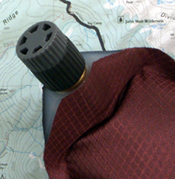
In one corner of the pad at the top is a two-piece plastic-coated brass screw-closed air valve. When turned clockwise it closes the valve. Turning it counter-clockwise opens the valve, releasing the air to empty the pad. Big Agnes calls the valve an "EZ-Flate mouthpiece". The bottom section of the valve spins open or closed while the top, or end, stays stationary in my mouth. The picture to the right shows the valve and the pattern of the nylon.
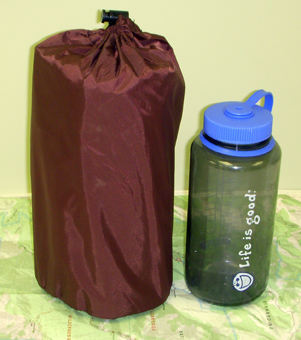
The IAC came with a brown nylon stuff sack that closes with a draw-cord and cord-lock. A pocket inside of the stuff sack contains a repair kit consisting of a rip-stop fabric patch and a small tube of glue. Here is a picture of it stuffed.
Field Conditions
I have used this current model on the following trips to date.
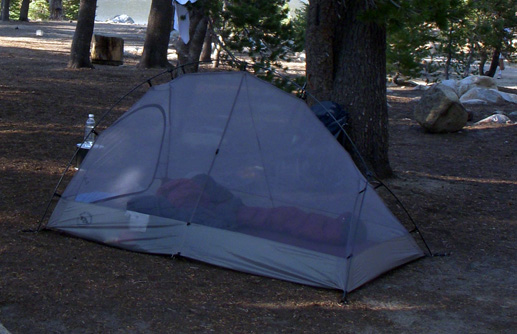
First was two nights in Yosemite National Park for a very hot and hard 44 miles (71 km) of backpacking, and another 3 miles (5 km) getting back to a road in temps up to 84 F (29 C) with 7790 ft (2374 m) of gain carrying a 36 lb (16.3 kg) pack. The picture below is from this trip. The pad is in my Big Agnes Seedhouse SL2, but it works in other company's tents too…
Then came a 79 mile (127 km) 3-1/2 day monster hike from Sonora Pass down through the Emigrant Wilderness to Tuolumne Meadows in Yosemite National Park. This hike saw 15200 (4633 m) of elevation gain with temperatures that ranged from 83 to 43 F (28 to 6 C). My starting pack weight with food and 3 qt/L water was exactly 37 lb (16.8 kg).
Dave and I spent two days in the Tehachapi Mountains just south of Sequoia National Forest. The temps were between 35 and 66 F (2 to 19 C). We went 42 miles (68 km). We had to carry all our water so my pack weight was 35 lb (15.9 kg) starting out.
I used it on a backpacking trip with Jenn to San Mateo Wilderness in Cleveland National Forest. We did a 9 mile (14.5 km) first day with an all up-hill 3.5 mile (5.6 km) hike back the next day. It hit 75 F (24 C) for a high but felt hotter in the sun, and got down to a chilly 28 F (-2 C) at night. High elevation was 2000 ft (610 m) with a total of 1300 ft (400 m) of elevation gain and loss. We were camped on packed dirt.
Observations
This is my second Insulated Air Core of this shape and size. (I also have the older mummy version seen above but am only writing about the use of the rectangular here.) My first IAC was one of the first sold by Big Agnes, and the subject of one of my first reviews for BackpackGearTest.org. After using that one for many years it developed a slow leak that I could not see. The leak got to where I had to blow it up a few times during the night. I finally decided to buy a new one and when I called Big Agnes they told me to send my old one in for them to look at it. I did and they emailed me to tell me that they were covering the old pad under warranty and sent me a new one. That is my kind of customer service.
A few things have changed with the pad since my early version. The insulation is now the recycled-content PrimaLoft Eco. It seems to work as well or better than the original PrimaLoft. I can definitely tell that the insulation sheet is much thicker than on my first one. While Big Agnes suggests the useful low temperature that it be used at is down to 15 F (-9 C) I have found that I will be cold on it any where lower than about 25 F (-4 C). I have used the original to even lower temps by placing a closed cell pad on top of the Insulated Air Core. This works very well, but now when the temperature is expected to be too low I just take one of Big Agnes' Dual Core pads instead.
There are two reasons I love these pads. First is the comfort. The difference between the Big Agnes pads with their 2.5 in (6.25 cm) of thickness and all my earlier pads is like night and day. The IAC allows me the space to adjust the inflation level to hard or soft support and still avoid hitting the hard ground with my hip and shoulder. (As a side sleeper I am prone to this happening a lot.)
It is comfortable to sleep directly on the pad too. This past fall was much hotter than normal and for five of the nights on this pad I just used my bag as a quilt to cover me as I lay on the IAC. I did not feel clammy from my skin being in contact with the nylon.
The second reason is how small they pack down to. They pack down to about half the size of my standard self-inflating or closed-cell pads. This lets me carry them inside of my pack instead of on the outside where it snags everything and gets dirty.
The extra 6 in (15 cm) of length over standard pad sizing works great for me too. It is so nice to not have my feet hanging off the pad during the night.
While I do have some Big Agnes sleeping bags that the pads are made to work with, I use them with all my other brands of bags too.
I have had no problems with the durability of this pad. (The older version mummy-shaped pad has much more use with zero problems too.) I was very worried on two nights in Emigrant Wilderness. The sites had a profusion of the sharpest pine needles I have ever seen. (Four months later I am still pulling broken off needles out of my blue foam sit pad from that trip.) I tried to brush as many clear as possible before setting my tent up but it was impossible to remove them all. To my surprise I got through both nights without having to break out the repair kit.
I love my Insulated Air Core pads and expect to be using them for a long time to come.
This report was created with the BackpackGearTest.org Report Writer Version 1.
Copyright 2009. All rights reserved.
Read more reviews of Big Agnes gear
Read more gear reviews by Ray Estrella
|