|
MONTRAIL HARDROCK MID TRAIL SHOES
TEST SERIES BY MIKE CURRY
LONG-TERM REPORT
July 18, 2008
CLICK HERE TO SKIP TO THE FIELD REPORT
CLICK HERE TO SKIP TO THE LONG-TERM REPORT
TESTER INFORMATION
|
NAME:
|
Mike Curry
|
|
EMAIL:
|
thefishguyAThotmailDOTcom
|
|
AGE:
|
38
|
|
LOCATION:
|
Aberdeen, Washington
|
|
GENDER:
|
M
|
|
HEIGHT:
|
5' 11" (1.80 m)
|
|
WEIGHT:
|
235 lb (107.00 kg)
|
I've been backpacking, climbing, ski-packing, bushwhacking, and
snowshoeing throughout the mountains of Oregon and Washington for
the last 25 years. I'm an all-season, all terrain, off-trail kind
of guy, but these days (having small kids) most of my trips run on
the shorter side of things, and tend to be in the temperate
rainforest. While I've carried packs (with winter climbing gear) in
excess of 70 pounds (32 kilos), the older I get the more minimalist
I become.
INITIAL REPORT
PRODUCT INFORMATION & SPECIFICATIONS
Manufacturer: Montrail
Year of Manufacture: 2008
Manufacturer's Website: http://www.montrail.com
MSRP: None Listed
Listed Weight: None Listed
Measured Weight (Pair): 2 lb 4.7 oz (1.04 kg) -- the left shoe is 3 oz (85 g) heavier than the right
Other details: US Size 12.5 (UK Size 11.5, EUR Size 46.5, CM 30.5)
DESCRIPTION OF MY FOOT
My feet are often challenging to fit, so a description seems necessary. I typically wear a US size 11, while for hiking shoes I usually go up to a US size 11 1/2 to allow for heavier socks and my feet swelling.
My arches are average, however my instep is high for the height of my arch. From the ball of my foot forward to my toes, my foot is very wide. While my heel is average width, the width of my foot just forward of my Achilles tendon (between the heel and the ankle bone) is very narrow.
The odd shape of my foot can make finding a shoe that fits well difficult. Average width shoes often constrict the ball of my foot and crowd my toes across their width. Wide width shoes often feel loose around my heel. High boots (as opposed to low trail shoes) generally don't fit well between the ankle bone and the heel, leaving a gap around this narrow part of my foot.
I also have prominent calluses that form on the ball of my big toes, and around the outer edge of my heel. I rarely find them problematic, though I have noticed that some shoes hasten their development.
INITIAL IMPRESSIONS
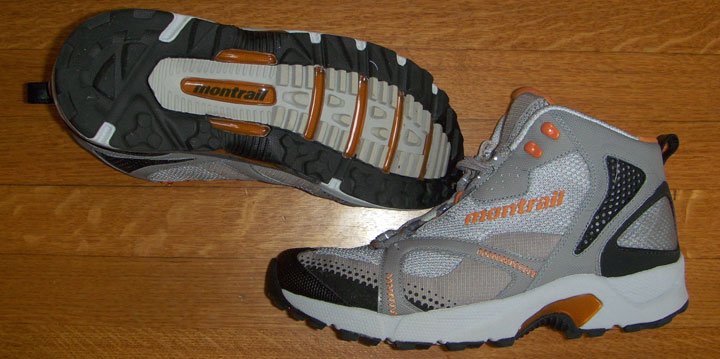 | | Montrail Hardrock Mid |
At first appearance, the Montrail Hardrock MID shoes are very similar to other trail shoes I own. Their uppers are a combination of man-made materials. The general design of these materials is visible in the photo above. The insole is a typical thin foam-rubber type. The midsole is described in the manufacturer's literature as a dual-density EVA material, which appears similar to me to those found on most trail shoes of this type. The sole is a combination of grey and black material (described in the manufacturer's literature as "Gryptonite") with transparent orange inlays that seem to be made of a plastic material. The shoe does not use eyelets for the laces, but rather loops of material, except the top two points, which are plastic hooks. Located on the tongue of the shoe is a double-loop for passing the laces through, and the tongue of the shoe is secured to each side by a section of flexible webbing. The tongue appears to be molded to better fit the contour of the foot, and is well padded. I would estimate the thickness of the tongue padding close to 1/2 inch (13 mm), and the padding is rather soft. This padding seems to be used around the entire upper ankle section as well.
Overall, the materials seem of good quality. The construction appears to be of better than average quality, with stitching being very consistent, and no loose stitches or glue points. Several seams are double needle stitched.
The height of this shoe is between that of low top trail shoes and high top trail shoes or boots. The front edge of the ankle opening is only slightly lower than most high top trail shoes and boots, while the back of the shoe is about 1 1/2 in (38 mm) lower than the front edge near the tongue. Wrapping around the heel is a fairly rigid heel support (which the manufacturer states is made of thermoplastic urethane). The foot is protected from the upper edge of this by the dense padding describe above.
The features that most struck me after initially looking over the shoes are:
Appearance -- I find them to be very nice looking.
Sole -- The soles have a fairly aggressive tread, something I look for in trail shoes.
Tongue Stability -- A combination of features (webbing connections, lacing points, and molded shape) appear designed to keep the tongue in place over my instep, something I look for in trail shoes.
Lacing Hooks -- The lacing hooks appear very strong and have a fairly deep groove for the laces. I've had problems with other trail shoes in this area, and scrutinize these features closely.
The only concerns that came to mind after initially looking over the shoe surround the complexity of the design. I will monitor the shoes closely for any signs of failure during testing.
TRYING IT OUT
As I've noted, these shoes are 1 US size larger than I normally wear in trail shoes. The fit is comparable overall to trail shoes I own that are 1 US size smaller, though these are slightly longer in the toe box. I would say the sizing of these shoes requires at least 1/2 US size larger than most shoes I've worn, and about 1 US size larger than some.
I initially tried the Montrail Hardrock Mid's on with my usual summer hiking socks, which are a mid-weight synthetic sock. I found tightening the laces to be comparable in complexity to other shoes I own, having to pull at two locations to draw the laces in snugly. The lacing hooks at the ankle allow the laces to be drawn snugly through them with very little effort.
Before standing up, I evaluated their fit without bearing weight on them. The padding on the tongue and ankle felt comfortable, as did the overall fit. The best description I can think of would be the shoes gently surrounded my feet, with plenty of room for my toes.
After standing up and taking a few steps, the overall feel changed slightly. The width of the shoes from the ball of the foot forward was not restricting, but rather holds the ball of the foot firmly and leaves the toes unrestricted. Due to sizing up to accommodate the shape of my foot, especially the width of my toes and the ball of my foot, there is excess room in the front of my toes, something I experience with most shoes due to the shape of my feet.
None of this was a concern, however, because of the fit at the instep. The shoes fit well at this point, in a way I would describe as gently firm. This keeps the shoe feeling very stable on my foot. The heel area feels roomy, almost as though there is a gap behind my heel. The heel does not seem to move at all in the shoe, however, and I suspect the sensation of space behind my heel is caused by a slightly different curvature to the heel than other shoes I own. It is quite comfortable, though a different feel than I am used to.
The underfoot padding of the insole and midsole felt very good. A few jogging steps where I intentionally came down hard on the heel tested the padding under impact. It provided very good cushioning from shock, without feeling spongy.
SUMMARY
Overall, I find the Montrail Hardrock Mid to be an attractive, well-designed, and comfortable shoe, though its fit is different than I am used to, and I require a full US size larger shoe than with most other brands for a comfortable fit.
FIELD REPORT
FIELD LOCATIONS AND CONDITIONS
I have worn the Montrail Hardrock Mid shoes virtually every day so far during the test period. They have been used for 4 nights of backpacking, approximately 9 day hikes, as well as around my house, office, and in my yard. They also were worn on a 6 mile bike ride to access a trailhead behind a locked gate. I have worn them while hiking in temperatures ranging from as high as 80 F (27 C), and as low as 28 F (-2 C). Weather conditions have included rain, mist, snow, hail, overcast, and sunny skies. Our wild spring weather this year has afforded me the opportunity to test these shoes under a wide variety of conditions.
All trips have been in the Olympic Mountains or along the coast of Washington, with elevations ranging from sea level to 1,500 ft (450 m).
I have used the shoes with a variety of socks ranging from cotton athletic socks to heavy wool winter hiking socks. I have used the shoes on surfaces including snow, mud, rock, gravel, cedar plank boardwalks, wet boat docks, duff, sand, dirt, asphalt, and concrete.
While it is difficult to estimate, I would suspect I have put about 100 miles (161 K) of use along trails on these shoes, and about the same or more in everyday wear.
PERFORMANCE IN THE FIELD
During field testing, comfort was one of my primary concerns. Having worn the Montrail Hardrock Mid trail shoes with a variety of socks, and once without socks, I would have to say I find them extremely comfortable. Even without socks, there is no stitching or rough edges that have caused any discomfort or chafing. The underfoot padding continues to provide adequate shock absorption, though it seems to be somewhat less cushy than the first time I put them on. The padding in the uppers, however, seems just as cushy as ever, and seems to have molded nicely to the contours of my foot. Though the heel cup continues to give me a feeling that they are going to slip, I've not experienced any slipping in that area, except when wearing extremely thick socks.
Thick socks, in fact, have been the only problematic ones I've had with these shoes. Even laced tightly, the shoe feels unstable to me with thick socks, as though my foot moves around somewhat. I don't believe my foot is actually sliding inside the shoe, but rather that the sock padding and shoe upper padding is being compressed, and my foot floats in all this padding. The only exception to this is the heel, where the space behind the heel does physically slip with heavy socks, but it has not caused any discomfort or blisters. I can lessen the overall "floating" feeling by lacing the shoes extremely tightly, but in doing so, I have had problems with the laces coming off the lacing hooks, a problem I've had with other sock combinations, but not to as great an extent. The laces seem more prone to pop off the lacing hooks when the shoes are laced tightly, and I believe it is caused by the padding beneath the hooks compressing and allowing the hooks to roll toward the front of my ankle, allowing ankle flex to pop the laces off.
With thin to average socks, the Montrail Hardrock Mids feel very stable.
Now that I have gotten used to the fit of the shoes, I would say they fit my feet quite well. The only design change I would make in regards to the general fit relates to the toe box. The toe box is rather pointed for my feet, and a more square toe box would provide a perfect fit without a small, pointed front section that I can stub against the ground while walking if I don't lift my feet all the way. I don't think people with normal shaped feet would have a problem with this, however, and it is barely noticeable to me anymore.
One other important comfort observation I have noticed has to do with temperature. I more often suffer from feet that are too hot than feet that are too cold while hiking, even in the winter months. I've found these shoes very comfortable in temperatures ranging from 28 F (-2 C) to about 65 F (18 C). Over this temperature range, however, I rapidly found them to be uncomfortably warm, even with thin cotton socks. They seem to breathe well, but the thick padding appears to act as an insulator. With my naturally warm feet, this limits their comfort range for me. I did not get the opportunity to test this below 28 F (-2 C).
Aside from comfort, the key areas I watched closely included general performance and wear. Aside from the laces tending to pop off the lacing hooks if laced very tightly (which did, on one occasion, put me flat on my face when the still-tied loop of laces hooked the lacing hook on the other shoe), I have found their performance outstanding. Also, the Hardrock Mid is not designed to be waterproof. It is worth mentioning that water readily penetrates these shoes, and even a quick step in deep water will leave my feet wet (which I find handy when my feet are hot). On the other hand, they also tend to drain and dry relatively quickly, with none of the chafing or discomfort I usually find with wet feet. I have just recently noticed that they have begun to take on that "old hiking boot" aroma that drives my wife into the far corners of the house when I come home. I will not be able to continue to wear them to work during long-term testing if a good airing-out doesn't resolve the problem, but I will still be able to provide plenty of trail mileage.
The traction these shoes provide has been excellent. While perhaps not as good in mud as lug soles, the soles have provided better than expected traction on the broad range of surfaces I've encountered. On wet rocks and slippery cedar boardwalks, they perform as good or better than any shoe I've ever tried. I feel the traction is one of the best compromises I've ever found for mixed surfaces.
Regarding wear, I'm equally impressed. I've put a lot of miles on these, and the soles show hardly any wear. The back edge of the midsole (behind and below my heel) shows some scuffing and compression wrinkles, but no signs of damage or missing chunks. Other than dirt and some scuffing, the uppers look just like they did out of the box, with no loose stitches or damage. The laces and lacing points show no sign of wear other than dirt and staining.
SUMMARY
The Montrail Hardrock Mids perform extremely well under a wide variety of conditions. Though I find them to be too warm for hot-weather hiking, they are very comfortable under the conditions we usually encounter during the spring on the coast of Washington. When laced tightly, the laces do occasionally pop off the lacing hooks, but this is easily remedied by not lacing the shoes so tightly. Tread wear and grip are both outstanding.
I wish to thank Montrail and BackpackGearTest for the opportunity to test the Hardrock Mid. My Long Term Report will be appended to this report in approximately two months. Please check back at that time for additional information.
LONG-TERM REPORT
LONG-TERM TEST LOCATIONS AND CONDITIONS
During the long-term test period, I have worn the Montrail Hardrock Mid shoes for approximately 200 miles (322 km) of use, evenly divided between trail wear and everyday wear. They have continued to be used on a variety of surfaces, and I was able to gain additional experience with them on slippery rocks and in late-season snow during the long-term test period.
I used the shoes on a 3 night coast trip, two 2-night weekend trips, and 12 day hikes during the long term testing period. Elevations ranged from sea level to 4,200 ft (1280 m). Temperatures ranged from 35 F (2 C) to 90 F (32 C). The shoes were used with light- and mid-weight socks.
PERFORMANCE IN THE FIELD
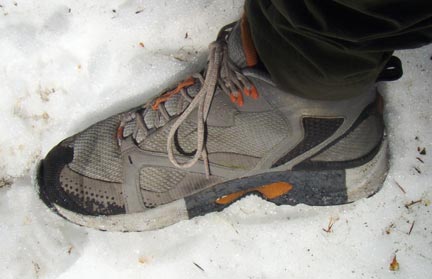 | | Hardrock Mids Still Looking Good after 400+ miles (640 km) |
The Montrail Hardrock Mid shoes have continued to perform well in the field. On wet and slippery rock along our coast, it performs as well as any footwear I've tried so far, and better than most.
In early July, I hiked into a lake that was still snowed over. Several miles of the trip were over corn snow, and the Hardrock Mid shoes performed very well, providing adequate traction even over some fairly steep terrain. Even wearing lightweight socks that day, my feet stayed nice and warm, although some snow did get in through the top when I post-holed one time. I was not wearing gaiters, as I expected the snow to be melted out. If they were waterproof, they would be one of my first choices for footwear while snowshoeing given their performance that day.
Despite the rather high mileage I've put on these shoes, they still look good, and continue to be very comfortable, and I seem to have adapted to how they fit my feet (I consider them one of the most comfortable pairs of shoes I own now). Other than some rounding-off of the edges of the tread, the soles show little wear, and still provide excellent traction. There is one location where the sole is pulling away slightly from the midsole, however in the last month and a half I have not noticed it getting any worse, and the area is so minimal that it is only noticeable under close inspection. I've not noticed any deterioration of the midsole or cushioning, other than the wrinkling of the midsole described in my field report.
The only problem I've had, and I hesitate to call it a problem, is that the laces continue to pop off the lacing hooks at the ankle about once a day. I've worried that this would happen at an inopportune moment (crossing a log, scrambling over wet rocks, etc.) and trip me, but so far it has only happened while walking on level ground on good trail. Normally it happens toward the end of the day, though checking and tightening the laces when I break for lunch hasn't seemed to help. Since I haven't seen it happen (but rather only noticed when the ankle suddenly felt loose) I'm not sure what's causing it. While I had originally suspected it may be caused by overly-tight laces, especially in conjunction with thicker socks, experimentation with lacing tension and thinner socks during long term testing showed it happened regardless of these factors.
At the end of the field testing portion of this test, the shoes had started to develop some odor. I retired them to my basement for a week to air out, and the odor went away. I'm happy to report it has not returned.
One thing I have noticed, especially in temperatures above 65 F (18 C), is that I find them a little warm for my comfort. While they breathe fairly well and allow perspiration to evaporate (my feet sweat, but it seems to wick away through my socks effectively), I do find my feet uncomfortably warm at times. My feet tend to be warm, anyway, and I think the exceptional padding of the shoes provides a little more insulation than my feet can take comfortably in the heat.
SUMMARY
The Montrail Hardrock Mid shoes have proven to be exceptionally comfortable and durable while providing excellent traction. They are a little warm for my tastes for summer use, but are just right for me in temperatures from about 65 F (18 C) down to freezing. Even though the laces seem to pop off the lacing hooks at the ankle about once a day while hiking, I've come to really enjoy these shoes.
CONTINUED USE
I will definitely continue to use the Montrail Hardrock Mid shoes in the future. They provide excellent traction on a variety of services, and I will likely use them during cooler spring, winter, and fall temperatures on trips where waterproof footwear isn't needed.
I wish to thank Montrail and BackpackGearTest for the opportunity to test the Hardrock Mids. This concludes my long-term report.
This report was created with the BackpackGearTest.org Report Writer Version 1.
Copyright 2008. All rights reserved.
Read more reviews of Montrail gear
Read more gear reviews by Mike Curry
|