|
LOWE ALPINE CERRO TORRE 65:85
TEST SERIES BY BRETT HAYDIN
LONG-TERM REPORT
INITIAL REPORT - October 27, 2009
FIELD REPORT - January 19, 2010
LONG TERM REPORT - March 16, 2010
TESTER INFORMATION
|
NAME:
|
Brett Haydin
|
|
EMAIL:
|
bhaydin AT hotmail DOT com
|
|
AGE:
|
37
|
|
LOCATION:
|
Salida, Colorado, USA
|
|
GENDER:
|
M
|
|
HEIGHT:
|
5' 11" (1.80 m)
|
|
WEIGHT:
|
195 lb (88.50 kg)
|
I started backpacking in Wisconsin as a youth, being involved in the Boy Scouts programs. As a young adult, I worked at a summer camp leading backpacking, canoeing and mountain biking trips. I now generally take short weekend or day trips in rough, mountainous terrain, although I have extensive experience in the upper Midwest as well. I take one or two longer trips each year, where I typically carry about 40 lb (18 kg). I prefer to be prepared and comfortable, but I have taken lightweight trips as well.
INITIAL REPORT
PRODUCT INFORMATION & SPECIFICATIONS
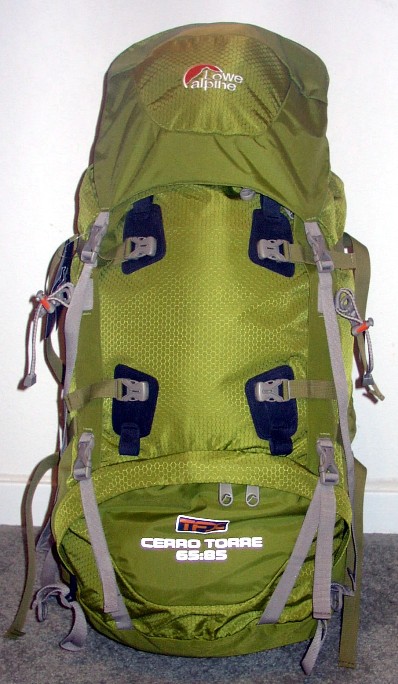 | | Lowe Alpine Cerro Torre 65:85 |
Manufacturer: Lowe Alpine
Year of Manufacture: 2009
Manufacturer's Website: www.lowealpine.com
MSRP: NA
Listed Weight: NA
Measured Weight: 6 lb (2.7 kg)
Color: Dark Pear
Volume: 65L (3,967 cu in) expandable to 85 L (5,187 cu in)
Torso: 16 - 23 in (41 - 59 cm)
Access: Top / Bottom / Front
Other Key Features:
- TFX® Torso Fit Expedition Fit System - Designed for backpacking where carrying heavy loads over multiple days
- Included rain cover with storage pouch
- Adaptive Fit hip belt - Provides additional comfort and fit
- Removable storage pouch for shoulder strap
- Hydration Bladder compatible
- Gear loops with trekking pole holder
INITIAL IMPRESSIONS
The Lowe Alpine Cerro Torre 65:85 is a generously sized backpack suitable for multi-day and extended backpacking trips. The Cerro Torre comes with a simple hang tag that contains some history of the company as well as the manufacturer's warranty.
When I first inspected the backpack, I was at once impressed with the quality of workmanship. I could find neither defects nor any flaws despite a thorough examination. In many areas, there are redundancies built into the stitching for added strength. The fabric appears to be made of a sturdy NHC330/TXP 600/1680 Ballistic material with hexagonal shapes. There are two main compartments in the backpack; one for my sleeping bag and the other for additional gear. The bottom of the sleeping bag compartment is lined with an additional layer of material presumably for added durability.
The lid of the backpack is well sized. There is plenty of room for my rain gear and other small items I may want readily. Built into the lid is a pouch with an included rain cover in the back of the lid. The rain cover is made of orange nylon and has an elastic bungee cord sewn into the hem for a snug fit around the full pack. There is a silver Lowe Alpine logo printed on the outside of the pack. On the bottom of the lid there is a zippered pouch similar to many other packs that I have owned where I will keep my map as needed. There are also universal distress signal instructions printed on the bottom of the lid, pictured below.
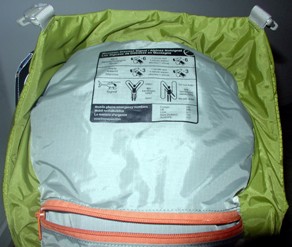 | | Bottom of lid |
To access the Cerro Torre, I can use the top opening or the front panels. I say panels because the sleeping bag compartment also has a zippered opening. The zippers are made of sturdy nylon zippers and have large plastic pulls that should be easy to grasp even with a gloved hand. For added protection from the elements, each zipper is covered by the ballistic material. For the main compartment, the webbing and buckle that attach to the lid is woven into the fabric that covers the zipper. The front panel also has four medium sized buckles holding the fabric in place. The buckles are sewn into the front panel on leather pads which also have small leather loops for stowing additional gear.
The sleeping bag compartment also has two straps of webbing and buckles on the exterior. These compress the compartment but I think they will also be perfect for attaching my sleeping pad and holding it in place. The sleeping bag compartment is generously sized and has more than enough space for my synthetic-filled sleeping bag. There is even room to store additional gear should I need it.
Inside the main compartment there is a pocket for a hydration bladder that accommodates my 3 L reservoir. There is a hook and loop tab that my reservoir can hang from as well. Upon further inspection, I noticed that there is a hook and loop closure that holds a horizontal aluminum stay that maintains a contour near the top of the pack. There is an opening in one side of the pouch that the hydration tube can exit the backpack. In the front pouch there is a zippered pocket, pictured below, in which I can also store additional gear. The main compartment and sleeping bag compartment are fully separated by continuous fabric but can be accessed by a zipper that stretches 3/4 of the way around the bag.
The main compartment of the Cerro Torre can also be extended by filling the upper portion past the first drawstring and cinching the second, uppermost drawstring. When not needed, this extra fabric easily packs into the main compartment. There is another strap of webbing and buckle that can compress the pack from the top and hold this extension securely in place. On either side of the pack there are two additional webbing compression straps that have buckles. These can also serve double duty and store additional gear on the outside. Both sides of the backpack have external pouches made of a stretchy synthetic material that can accommodate water bottles or other similar items. Near the bottom of either side there are additional gear loops as well.
One feature worth pointing out is a clever gear loop that has a dual design of holding my trekking poles in place. The gear loop has a small plastic disc that is cut in the middle so I can push the end of my pole through it. The pole portion is held in place about halfway up the pack by an elastic bungee cord with a hook design to hold the pole in place. This design works equally as well with my ice axe as the plastic disc is built into a typical gear loop.
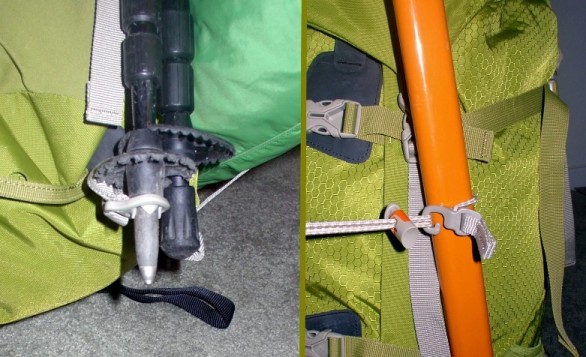 | | Gear Loop Attachment Points |
The hip belt is well padded and is fully adjustable for my size. The hip belt uses Lowe Alpine's adaptive fit system which contours the padded belt to my waist as I tighten it. There is more information available on the manufacturer's website about the technology. The shoulder straps are also well padded. Included in the Cerro Torre is a removable zippered pouch suitable for a cell phone or small camera that attaches to the shoulder strap. Since there are no pockets on the hip belt, this might be a handy feature. The sternum strap is adjustable via piping that is built into the shoulder strap. Finally the sternum strap buckle has a built in whistle for emergencies, or for just plain old fun.
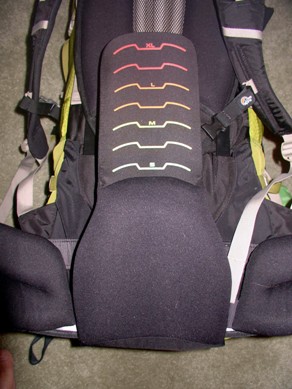 | | TFX System |
The Cerro Torre features the TFX (Torso Fit Expedition) system that allows for easy and on-the-fly adjustment of the torso size. Using the manufacturer's chart available on the website, the torso size can be adjusted by removing the lumbar support from the rear padding. Doing so allows the padding to slide freely up and down the aluminum stays. There is a webbing strap and buckle that may need to be loosened depending on my personal fit. Using the color coded system, I can adjust the support to my preference, tighten the webbing to that fit and replace the lumbar support into the padding. There are hook and loop tabs that further keep the torso system in place. One final note about the rear padding is that the polyethylene foam is covered by a mesh material in portions so that air may flow and make my back more comfortable as I perspire.
READING THE INSTRUCTIONS
As noted before, there is very little information about the pack available yet, leaving me to figure out many of the features and uses on my own. There are some care instructions included on a tab sewn into the interior main compartment. The instructions are general and easy to follow.
For the most part, I believe I understand a number of the features. Many features are already included on other Lowe Alpine packs so information on how to use these is easily available by looking through the manufacturer's website and catalogue.
TRYING IT OUT
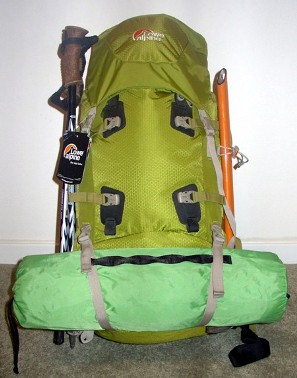 | | Packed up and ready to hit the trail! |
The Cerro Torre is quite adequate for my personal needs. I have used both larger and smaller packs in the past, but what really impresses me with this pack are the well thought out design features. Having a place to store both ice axe and trekking poles is a real plus for me. I did take the opportunity to load up the pack with about 40 lb (18 kg) worth of gear, pictured below, and found that the pack carries the load just fine. While the current model I am testing does not state it, previous models are rated to carry loads of 55-66 lb (25-30 kg).
SUMMARY
I am very excited to get out and try the Lowe Alpine Cerro Torre 65:85! I love the colors and the size is fantastic for my needs. I am curious to see how much I use the various features over the testing period.
I would like to thank Lowe Alpine and the monitors at BackpackGearTest.org for allowing me to be a part of this test series. Please check back in approximately two months for the field report.
FIELD REPORT
FIELD LOCATIONS AND CONDITIONS
Over the past two months, I have used the Cerro Torre on three backpacking trips totaling 7 days and four nights. All of the hikes took place in the Rocky Mountains of central Colorado.
My first overnight trip was into the Collegiate Peaks Wilderness along the Browns Pass Trail. While hiking in the area over the summer, I noticed a turnoff to Lake Hartenstein that I wanted to visit. Elevation for this trip ranged from approximately 9,900 to 11,500 ft (3,018 to 3,505 m) and while the trail was snow covered in spots, the snow was noticeably deeper over 10,500 ft (3,200 m). Weather was cold with a low of 10 F (-12 C) when I checked in the middle of the night. The high was about 40 F (4 C). While the skies were overcast on the hike in, they cleared up at dusk and remained clear the rest of the trip. The hike into the lake is a fairly easy 3 mi (4.8 km), but I spent a fair amount of time exploring the area as well.
The second trip was along a section of the Rainbow Trail in the San Isabel National Forest. For this trip I hiked about 6 mi (9.6 km) in to a suitable camping spot. The weather was fantastic with temperatures near 40 F (4 C) and mostly sunny skies. Overnight low was about 20 F (-7 C). The trail was in great shape considering the amount of snow the area has seen recently and snowshoes were only needed in particular areas. Elevation range was approximately 8,500 to 9,800 ft (2,590 to 2,990 m).
My final trip was a three day trip into the Collegiate Peaks Wilderness area to the Harvard Lakes region, elevation 10,300 ft (3,139 m). My partner and I hiked approximately 4 to 5 mi (6 to 8 km) each day. Except for the hike to the lakes, we cut our own trail trails through snow that was 12 to 24 in (30 to 60 cm) deep. The weather was fair; mostly cloudy with periods of clear skies and very little wind. Temperatures ranged from 10 to 40 F (-12 to 4 C).
PERFORMANCE IN THE FIELD
I am quite happy with the capacity, comfort and characteristics of this backpack. There are a few features that I think could be improved upon, and even fewer I could do without. Read on to find out why.
Despite trying to pack as much gear as I can reasonably carry, I have yet to find that I am without the space I would need. My heaviest load measured 50 lb (22.7 kg) on my three day trek. Of course, that was on my first day and I was carrying more than I would normally carry in water weight, I found that the Cerro Torre easily handled the load and I was able to adjust the load straps on the fly with ease. The compartments are well laid out and there is ample room in the places I normally carry my gear.
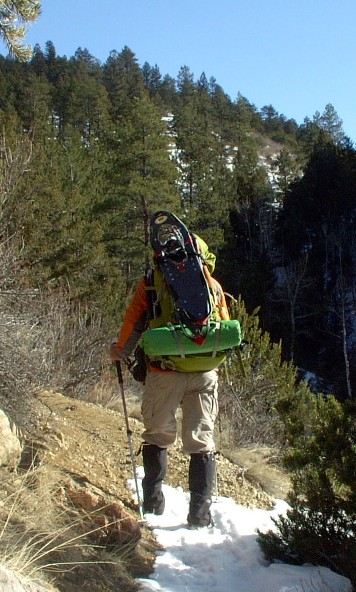 | | With snowshoes |
On my last trip, I carried the following:
Lower (sleeping bag) compartment:
- Sleeping Bag (North Face Snowshoe)
- Cook set (consisting of pot and lid, pot handle, MSR WhisperLight stove, soap, camp towel and lighter)
Main Compartment
- 2 L CamelBak reservoir
- Fuel Bottle
- Food bag (2 dehydrated dinner meals, 4 packets of oatmeal, ingredients for bannock, coffee and tea for trip, 2 dehydrated egg meals, packet of 8 bagels, trail mix, 3 energy bars)
- Stuff Sack with extra clothing (extra socks, underwear, gloves, hat, mid weight fleece pants)
- tarp and ground cloth
- shovel
- crampons
- mess kit with plate, cup, and utensils for cooking
Inside compartment of front panel:
- Camp Journal
- Ten essentials bag with toiletries
- bundle of cordage
Top Pouch (lower)
- trowel and TP roll
- cell phone and wallet
Top Pouch
- Shell Jacket and pants
I also carried two 1 L bottles of water, ice axe, hot beverage mug and a sleeping pad in pouches or otherwise attached to the exterior of the backpack. In the electronics pouch, I carried a GPS unit and on the waist belt I attached a camera case for a film SLR camera. This was typical of my other trips, except I carried the full tent, rather than fly and ground cloth. When the conditions warranted, I also strapped my snowshoes on the back of the pack as well, as the picture to the left shows.
The first point I would like to make is that this pack is well padded in the right places for me. Looking at the shoulder straps, I was skeptical that there would be enough padding, but I am pleasantly surprised that the pads have exceeded my comfort expectations so far. Also, I am accustomed to pressure on my hip bones, but have not experienced that at all with the Cerro Torre. I believe the secret lies in the adaptive fit hip belt. As I tighten the belt, I can really feel the belt form around my hip. It is really quite comfortable. My only complaint with the hip belt is with the strap itself. I have a camera case for my SLR camera that fits onto the hip belt strap, but the weight of the case causes the strap to bunch up at the buckle closest to the pack. This renders one half of the buckle essentially useless for tightening. Fortunately, there is enough material on the other half to make the necessary adjustments.
I am very happy with the layout of compartments so far. The sleeping bag compartment is more than large enough for my synthetic sleeping bag, as bulky as it is. There is even room enough for my cook set to fit in there as well! I see two minor drawbacks with this compartment. First, the zippered separator from the main compartment can only be unzipped (or zipped) from the sleeping bag compartment side. This was a slight issue when I took a slightly larger than usual cook pot. While there was room enough inside, the exterior access panel did not allow enough room to squeeze the pot in. I was able to fit the pot in, but could not fully close the separating panel. Second, the pull tabs for the zippers are great on the exterior panel; however the material covering the zipper gets in the way of operating the zippers efficiently. The material is stiff and just seems to get in the way. The pull tabs are generously sized and are easy to grasp even with fully gloved hands. The trade off for weather-resistance is well worth the inconvenience, but it is a minor issue for me.
I find the same flaw with the main access panel on the front of the backpack. Once again, the pull tabs are generously sized, compensating for the awkwardness. My hiking partner also commented that the pull tabs were great, especially for winter camping and gloved hands! I have found no use for the compression straps that attach to the front panel so far. The straps really don't provide any appreciable compression, and when I tried to attach my crampons to them as an external carrying method, it was difficult to unbuckle the straps. There are also four gear loops on the front panel, but the top two are close to the overlapping weather stripping covering the zipper making then a little difficult to access with gloved hands.
I find that the ventilation on the back is great so far. During the winter, I tend to layer up, but I have noticed that the build up of perspiration is not as much as with other packs I have owned. While I appreciate that the frame size is easily adjusted, I have not needed to adjust the size at all since I originally set it. Another great feature I have noticed is the generous "noggin notch." This is a section of the pack where normally my head hits the backpack as I look up. There is a notch shaped into the frame that prevents this from happening, even when wearing a helmet.
Another feature I really like is the gear attachments and loops. Attaching an ice axe or trekking poles could hardly be any easier with the simple bungee cord system. It is quick to release and easy to lock my accessories into place. Finally, I really like the electronics pouch that can be attached to the shoulder strap. My wife bought me a GPS for Christmas and I absolutely love being able to stow it within easy access. I have also used it for a small camera, but found that I wished it had more padding for that purpose. With my GPS, I can make sure that the screen faces the shoulder strap to protect it from accidental damage. With my camera, I am nervous about both the screen on the rear and the lens on the front.
Durability has not been a concern whatsoever. The only wear that I have noticed to date is some minor fraying on the hook and loop tabs that suspend the hydration reservoir. Since this doesn't need to be adjusted regularly, I am not concerned at this time.
SUMMARY
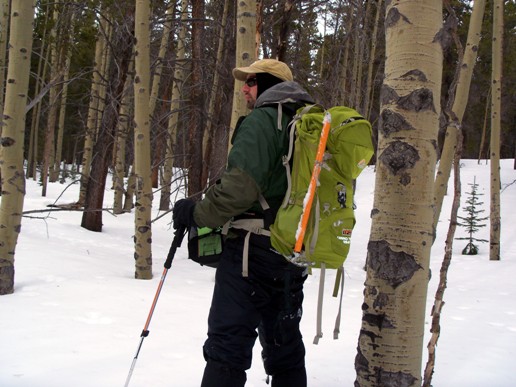 | | Using as a day pack |
Overall I am really excited about this pack. It can hold a large amount of gear for winter camping and is the most comfortable overnight pack I have owned. There are a lot of well thought out features, such as the gear loops and bungee cord system, integrated pack cover and easy to access pull tabs for the zippers. While camping up at Harvard Lakes, I also used the pack as a day pack for one of our exploratory hikes and it didn't feel too bulky!
There are just a few nuances that I feel could be improved upon, such as the weather stripping covering the zippers and the one-sided zipper between interior compartments. It would be nice to find a manner in which to keep my SLR camera handy, but I will explore other options over the next two months.
This concludes my Field Report. Please check back in approximately two months to see how the Cerro Torre has performed after another two month of testing!
I would like to thank Lowe Alpine and all the volunteers at BackpackGearTest for allowing me to be a part of this test series.
LONG-TERM REPORT
LONG-TERM TEST LOCATIONS AND CONDITIONS
Over the last two months I took the Cerro Torre on an additional two backpacking trips. The first was an overnight trip along the Colorado Trail, just below Mt Yale camping for the night at 10,500 ft (3,200 m). My dog and I hiked about 5 mi (8 km) along snow packed trails in mountainous terrain. The weather on this trip was cloudy with a high near 35 F (2 C). My thermometer read just below 20 F (-7 C) when I turned in for the night.
My final trip was in the San Juan National Forest in Colorado to Ptarmigan Lake, at an elevation of 12,147 ft (3,702 m). The trail to the lake was fairly moderate and snow packed. Like any mountain terrain, some sections were steeper than others! Temperatures were between 10 and 35 F (-12 and 2 C) and while the weather was fair during the day, it turned into snow from dinner until I arrived back at my car.
All told, I have used this pack for 11 days and 6 nights of backpacking.
PERFORMANCE IN THE FIELD
I have continued to enjoy using the Cerro Torre on my backpacking trips this winter. Throughout the testing period all the belts, buckles, zippers and other features performed flawlessly. I have inspected the pack inside and out and the only sign of wear and tear is on the hook and loop tab that secures the hydration bladder in the inside of the main compartment. I have noticed this on many other hook and loop tabs in various pieces of gear so I consider this normal.
As the winter has continued on, I have found this pack well suited to winter travel. Not once have I been able to fill the pack up with the amount of gear I am willing to actually carry on long distances. My pack has generally carried the same type of load that I outlined in the field report. However I added a few items these last two trips. Some of these items were a Crazy Creek chair, down booties and an insulated mug.
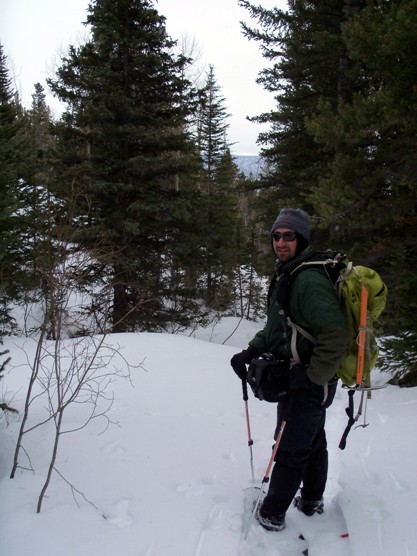 | | Out on the trail! |
I am really impressed with the accessory straps on the outside of the pack. The image to the right shows a good shot of my ice axe occupying this space while hiking. I find it really easy to access this when the pack is off, but I can't really get at it when I am wearing the pack. As far as I am concerned that is fine since I don't think I need a "quick release" set up on a multiday pack! At times I have used the loops on the front of my pack to lash additional items with simple cord. I found this easy whether I used bungee cords or standard cordage.
One aspect that somewhat frustrated me at times was the zippers. While the tabs are easy to grasp, even with a gloved hand, I continue to find it somewhat difficult to open or close the zippers due to the stiff fabric covering the zippers themselves. After experimenting with the pack these past two months I think I have identified my issue. I am used to pulling the tab out, away from the zipper as I pull it open or closed. I found it easier if I used the thickness and length of the zipper pull to make the pull perpendicular to the zipper and slide it back and forth that way. It still gives me problems, but I think I found a happy middle ground!
I mentioned that the hook and loop tab is showing signs of fraying or wear. In addition, I have also found my hydration bladder hanging freely after a day of hiking. I cannot say that this is because of user error or design, but in my opinion a simple loop or plastic tab might be sufficient.
A feature I really like is the ability of the pack to shed wet snow and keep my gear dry. I have used the pack cover at times of heavy snow and that certainly worked well. I also have placed the pack down on the front and in the snow for long periods of time while I set up camp. I do this so the snow doesn't stick to the back and then melt against my back when I put it back on, but it is great to know that the protection is there. I did not encounter any rain this winter, but I am confident in the performance I saw thus far.
One feature I do miss on this pack is the ability to remove the top pouch and use it as a day pack. This is more of an issue for me in the summer time, so I didn't miss it too much! In the winter I sometimes strap on my snowboard and a backcountry day pack for backcountry day trips, but I haven't done much of that this year because our local resort has had fantastic powder so far! As I mentioned above, I have room left inside the pack to make this work for me.
Adjusting the pack continues to be a simple process thanks to the TFX 10 and adaptive fit features. I have not really noticed the pack shifting, but every once in a while I have had to tighten the hip belt. It isn't frequently, perhaps every three hours or so. I tend to shift how the pack sits on me from time to time to give parts of my body a rest. The padding continues to be excellent. I really like how this pack feels!
SUMMARY
I have been extremely happy with Lowe Alpine's Cerro Torre 65:85. This is a high-quality, high-capacity backpack that has a well planned design. Lowe Alpine has a real winner here!
Things I really like:
- Very generously sized
- Rain cover is included in pack
- Seems to shed weather well so far
- Excellent durability
- Padding is very comfortable
Things I would change:
- The hook and loop tab could by simplified for hydration bladders
- A camera pouch on the hip belt would be a nice touch
- Zippers can be a little difficult to operate
CONTINUED USE
The Lowe Alpine Cerro Torre 65:85 will definitely be my pack of choice during all of my winter travels. As much as I tried to overstuff the bag, I always seemed to have room for more if I needed it. During the summer months, I will likely continue to use this pack for the time being, but I am not sure that I will need the volume this pack provides in the long run.
I would like to extend my sincere thanks to Lowe Alpine for allowing me to be a part of this series as well as to all those at BackpackGearTest.org who made this series possible.
This report was created with the BackpackGearTest.org Report Writer Version 1.5
Copyright 2010. All rights reserved.
Read more reviews of Lowe Alpine gear
Read more gear reviews by Brett Haydin
|